

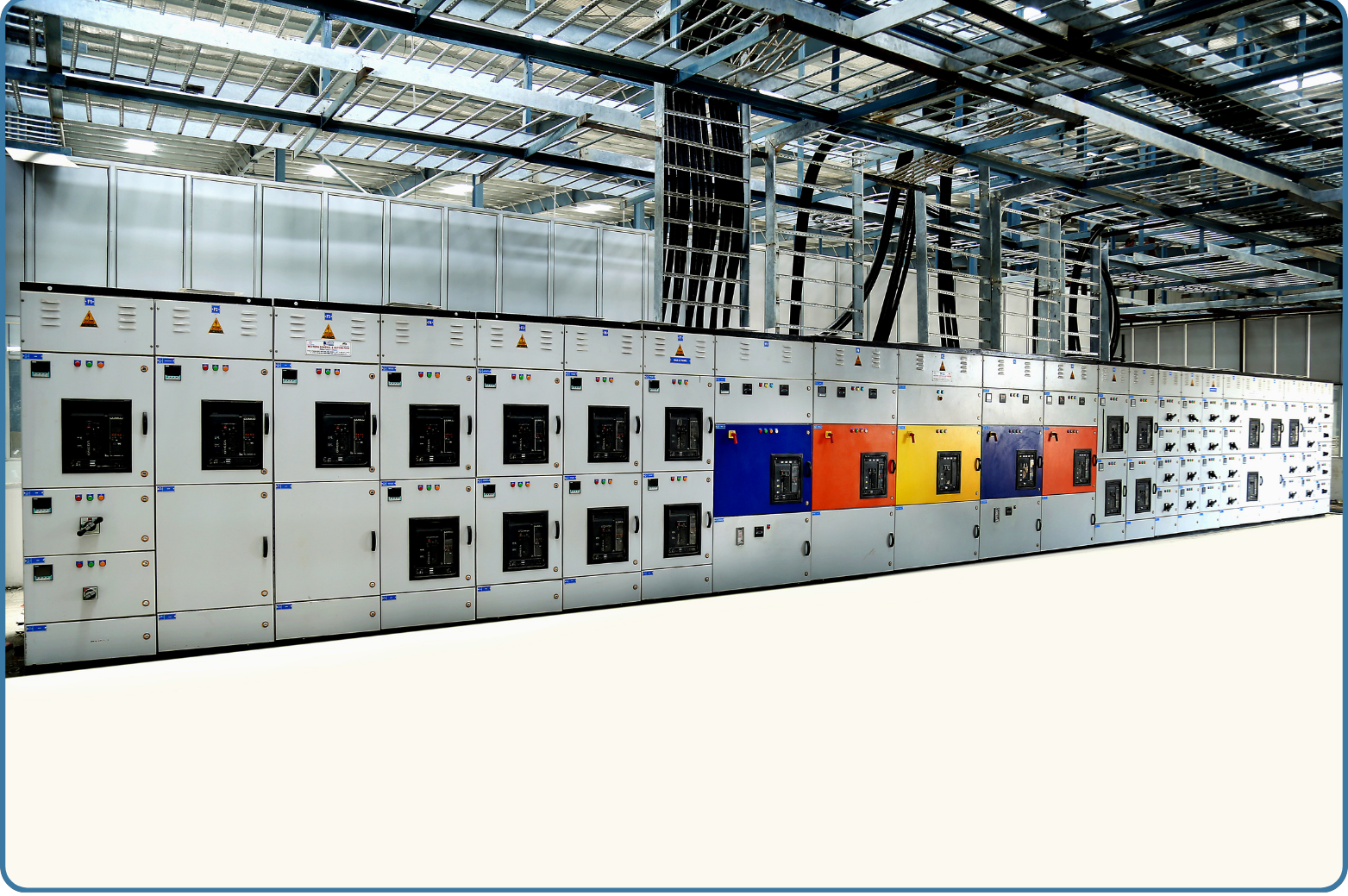
E-Tech Power Engineers is a LT Panel Manufacturer in Delhi NCR, offering customized Low Tension Electrical Panels for industrial, commercial, infrastructure and building electrical systems.
An LT Panel is used for receiving, controlling, protecting and distributing low-voltage electrical power to different loads, feeders and downstream distribution systems. Depending on the application, an LT Panel can be configured as a Main LT Panel, LT Distribution Panel, PCC, feeder panel, incomer-outgoing panel or a customized low-voltage switchboard.
E-Tech Power Engineers designs and manufactures customized electrical panels from its facility in Greater Noida and serves customers across Delhi, Noida, Greater Noida, Ghaziabad, Faridabad and Gurugram. The company’s listed product range includes LT Panels, PCC Panels, MCC Panels, AMF Panels, PLC Panels and other electrical control panels.
What Is an LT Panel?
LT Panel means Low Tension Panel. It is a low-voltage electrical switchboard used to receive electrical power from a transformer, DG set or another incoming source and distribute it safely to different electrical loads.
A typical LT Panel may contain an incomer breaker, busbar system, outgoing feeders, metering, protection devices, control components and cable termination arrangements.
The exact configuration depends on the connected load, fault level, incoming source, number of outgoing feeders and project requirements.
How Does an LT Panel Work?
The basic power flow is:
Incoming Supply → Main Incomer → Busbar → Outgoing Feeders → Electrical Loads
The incoming breaker receives power from the source and feeds the panel busbar. Outgoing breakers then distribute power to different loads or downstream panels.
Protection devices are selected to help isolate abnormal conditions such as overloads and short circuits.
Metering equipment can also be incorporated to monitor parameters such as voltage, current, power, energy and power factor.
Main Functions of an LT Panel
An LT Panel can be designed to perform several important functions:
- Power receiving
- Power distribution
- Circuit protection
- Feeder isolation
- Electrical metering
- Load management
- Generator supply integration
- Transformer output distribution
- APFC integration
- DG synchronization integration
- Energy monitoring
- Emergency supply distribution
The actual functions depend on the panel design and project requirements.
Types of LT Panels
Main LT Panel
A Main LT Panel is generally installed at the main power receiving/distribution point of a facility.
It can receive power from a transformer, DG system or other low-voltage source and distribute it to downstream PCCs, MCCs, DBs or other electrical loads.
LT Distribution Panel
An LT Distribution Panel distributes electrical power through multiple outgoing feeders to different sections of a facility.
LT PCC Panel
A Power Control Centre can be designed for centralized distribution and control of electrical power for industrial and commercial installations.
LT MCC Panel
An MCC is designed primarily for controlling and protecting motors and motor-driven equipment.
DG/AMF Integrated LT Panel
Where required, LT panels can be integrated with DG, AMF or changeover arrangements according to the project’s electrical architecture.
Customized LT Panel
Customized LT Panels can be designed according to:
- Incomer configuration
- Outgoing feeder requirements
- Breaker ratings
- Busbar rating
- Metering requirements
- Protection scheme
- Indoor/outdoor installation
- Cable entry arrangement
- Automation requirements
Main Components of an LT Panel
Depending on the design, an LT Panel may include:
- ACB
- MCCB
- MCB
- Isolator
- HRC fuse
- Copper or aluminium busbar
- Protection relays
- Multifunction meters
- Energy meters
- CTs
- Surge protection device
- Control transformer/SMPS
- Auxiliary relays
- Terminal blocks
- Indication lamps
- Selector switches
- Cable glands
- Cable termination arrangement
- Earthing arrangement
The exact component selection should be based on the approved electrical design and required ratings.
LT Panel Protection
Protection is one of the most important aspects of LT Panel design.
Depending on the application, the panel can incorporate protection against:
- Overload
- Short circuit
- Earth fault
- Over-voltage
- Under-voltage
- Phase failure
- Other electrical abnormalities as required
Breaker selection and protection settings should be coordinated with the upstream and downstream electrical system.
LT Panel with ACB and MCCB
ACB and MCCB are commonly used in low-voltage distribution systems.
ACB is generally used for higher-current incomer or feeder applications where its functionality and rating are suitable.
MCCB is commonly used for outgoing feeders and distribution circuits.
The actual breaker type and rating should be selected according to load current, fault level, coordination requirements and project specifications.
LT Panel Busbar System
The busbar is a critical part of an LT Panel because it carries and distributes electrical current between the incomer and outgoing circuits.
Busbar design considers:
- Rated current
- Short-circuit withstand capability
- Material
- Temperature rise
- Insulation/clearances
- Physical arrangement
- Connection method
Copper or aluminium busbars can be considered according to the project specification.
LT Panel Metering
Depending on the application, an LT Panel can include meters for monitoring:
- Voltage
- Current
- Frequency
- kW
- kVA
- Power factor
- Energy consumption
For larger installations, communication-enabled meters can be integrated with an energy monitoring or automation system where required.
LT Panel Applications
LT Panels are used across many electrical installations, including:
- Manufacturing plants
- Industrial facilities
- Commercial buildings
- Warehouses
- Shopping malls
- Hospitals
- Hotels
- Institutional buildings
- Infrastructure projects
- Water treatment plants
- Process industries
- Utility installations
The panel configuration should be selected according to the electrical load and operating requirements of each facility.
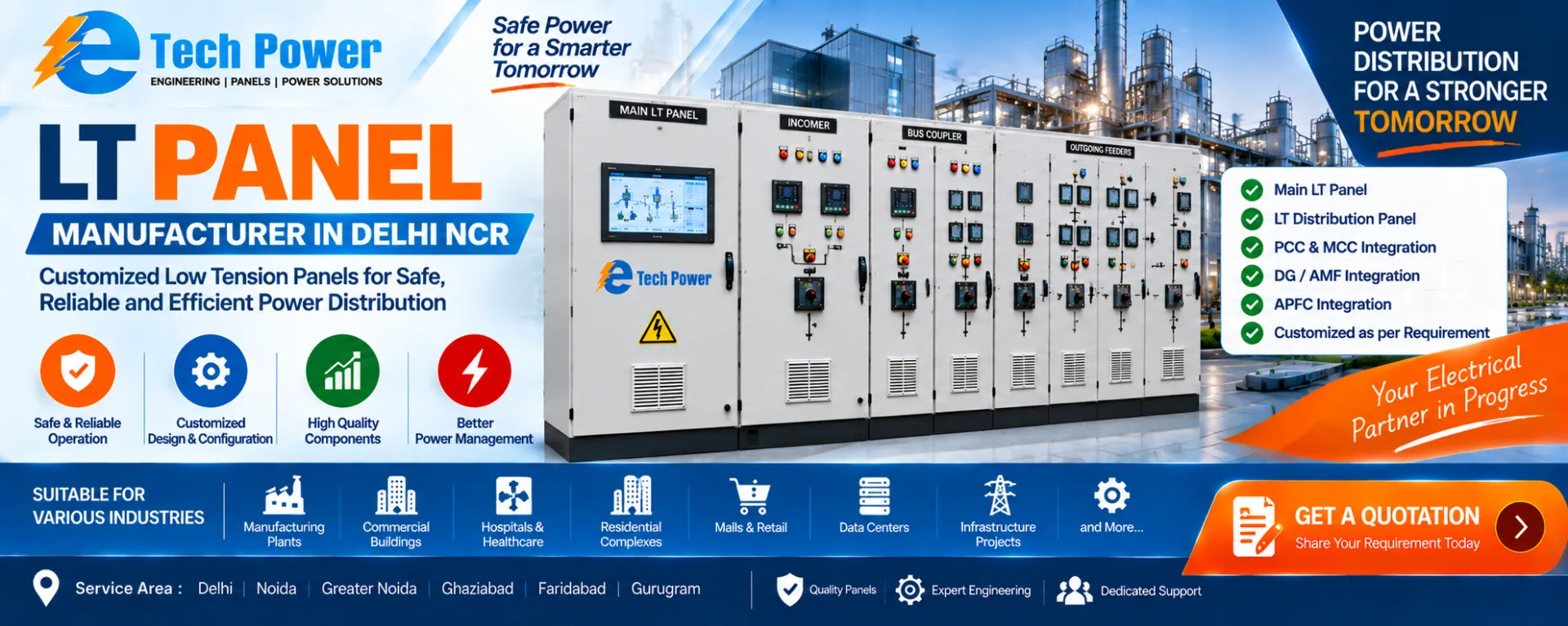
LT Panel vs PCC Panel vs MCC Panel
| Panel | Primary Purpose |
|---|---|
| LT Panel | General low-voltage power receiving/distribution |
| PCC Panel | Centralized power control and distribution |
| MCC Panel | Motor control and protection |
| APFC Panel | Power factor correction |
| AMF Panel | Automatic mains failure/generator changeover functions |
| PLC Panel | Automation and process control |
A project can use more than one of these panels as part of the overall electrical distribution and automation system.
LT Panel Selection Guide
Before selecting an LT Panel, consider:
- Incoming power source
- Transformer/DG capacity
- Connected load
- Maximum demand
- Incomer rating
- Number of outgoing feeders
- Short-circuit level
- Busbar rating
- Breaker type
- Metering requirement
- Protection scheme
- Indoor or outdoor installation
- Cable entry direction
- Future expansion requirement
- Automation/communication requirements
This information allows the manufacturer to develop an appropriate panel configuration rather than selecting a panel only on the basis of current rating.
LT Panel Technical Specifications
LT Panels can be customized according to project requirements.
| Parameter | Typical Configuration |
|---|---|
| Application | Low-voltage power distribution |
| System | 3 Phase / 4 Wire, as required |
| Voltage | As per project |
| Frequency | As per project |
| Incomer | ACB/MCCB as required |
| Outgoing | MCCB/MCB/other suitable devices |
| Busbar | Copper/Aluminium as specified |
| Metering | Digital/Multifunction meter |
| Protection | As per approved scheme |
| Enclosure | Indoor/Outdoor as required |
| Mounting | Floor mounted / suitable configuration |
| Cable Entry | Top/Bottom as required |
| Finish | Industrial powder-coated finish |
| Customization | Available as per project |
Important: Do not publish a blanket rating such as 5000A, 6300A or 690V on the page unless E-Tech Power’s actual design, components, assembly and applicable verification/testing support that rating. Some third-party listings show configurations up to 5000A/415V, but these should not automatically be treated as a universal company rating.
LT Panel Manufacturing Process
A typical manufacturing workflow includes:
Requirement Analysis → Electrical Design → Component Selection → Enclosure Fabrication → Busbar Assembly → Wiring → Component Installation → Inspection → Testing → Packing & Delivery
For project-specific panels, the final manufacturing process should follow the approved drawings and specifications.
E-Tech Power’s website describes a workflow covering consultation, design and engineering, manufacturing and testing.
LT Panel Testing
Depending on the agreed project scope, inspection and testing may include:
- Visual inspection
- Wiring verification
- Continuity checks
- Insulation resistance testing
- Functional testing
- Metering verification
- Protection/control checks
- High-voltage testing where applicable and actually performed
Testing should be stated according to the actual equipment, applicable standards and testing facilities available.
LT Panel Price in Delhi NCR
The price of an LT Panel depends on:
- Panel current rating
- Number of feeders
- ACB/MCCB selection
- Busbar material and rating
- Short-circuit requirement
- Metering
- Protection system
- Panel dimensions
- Indoor/outdoor construction
- Automation requirements
- Installation and commissioning scope
Therefore, there is no single standard price for every LT Panel.
For an accurate quotation, share your load requirement, incomer rating, number of outgoing feeders and electrical single-line diagram (SLD).
LT Panel Manufacturer in Noida, Greater Noida & Ghaziabad
E-Tech Power Engineers is located at Plot No. 91, Udyog Kendra-II, Ecotech-III, Greater Noida – 201306. The company is listed as a supplier/manufacturer of LT Panels and other electrical control panels in Greater Noida.
The company can serve projects in:
- Delhi
- Noida
- Greater Noida
- Ghaziabad
- Faridabad
- Gurugram
- Manesar
- Sonipat
- Bhiwadi
- Neemrana
Actual installation and service scope should be confirmed based on project location.
Why Choose E-Tech Power Engineers?
For an LT Panel project, the important factors are electrical design, component selection, protection coordination, busbar design, workmanship and project-specific customization.
E-Tech Power Engineers provides customized electrical panel solutions based on project requirements and lists LT Panels, PCC, MCC, AMF, PLC and other control panels within its product portfolio.
Frequently Asked Questions
What is an LT Panel?
An LT Panel is a low-voltage electrical switchboard used to receive, protect, control and distribute electrical power to multiple circuits or loads.
What is the difference between LT Panel and HT Panel?
An LT Panel is designed for low-voltage electrical distribution, whereas an HT panel is used for higher-voltage electrical systems and requires different switchgear, insulation and protection arrangements.
What is a Main LT Panel?
A Main LT Panel is generally the primary low-voltage distribution panel receiving power from a transformer, DG or another electrical source.
Can an LT Panel be customized?
Yes. LT Panels can be customized according to incomer, outgoing feeders, current rating, busbar arrangement, metering, protection, enclosure and installation requirements.
Can an LT Panel include ACB?
Yes. An ACB can be used as an incomer or feeder device where its rating and functionality are appropriate for the application.
What information is required to get an LT Panel quotation?
The most useful information includes the electrical SLD, transformer/DG rating, connected load, incomer rating, number of outgoing feeders, fault level and required protection/metering.
Is LT Panel suitable for industrial applications?
Yes. LT Panels are widely used for industrial power distribution, provided the panel is correctly designed for the electrical load, fault level and operating conditions.
Get a Customized LT Panel Quotation
Looking for an LT Panel Manufacturer in Delhi NCR?
Share your SLD, transformer/DG capacity, load details and feeder requirements with E-Tech Power Engineers for a project-specific LT Panel solution.