

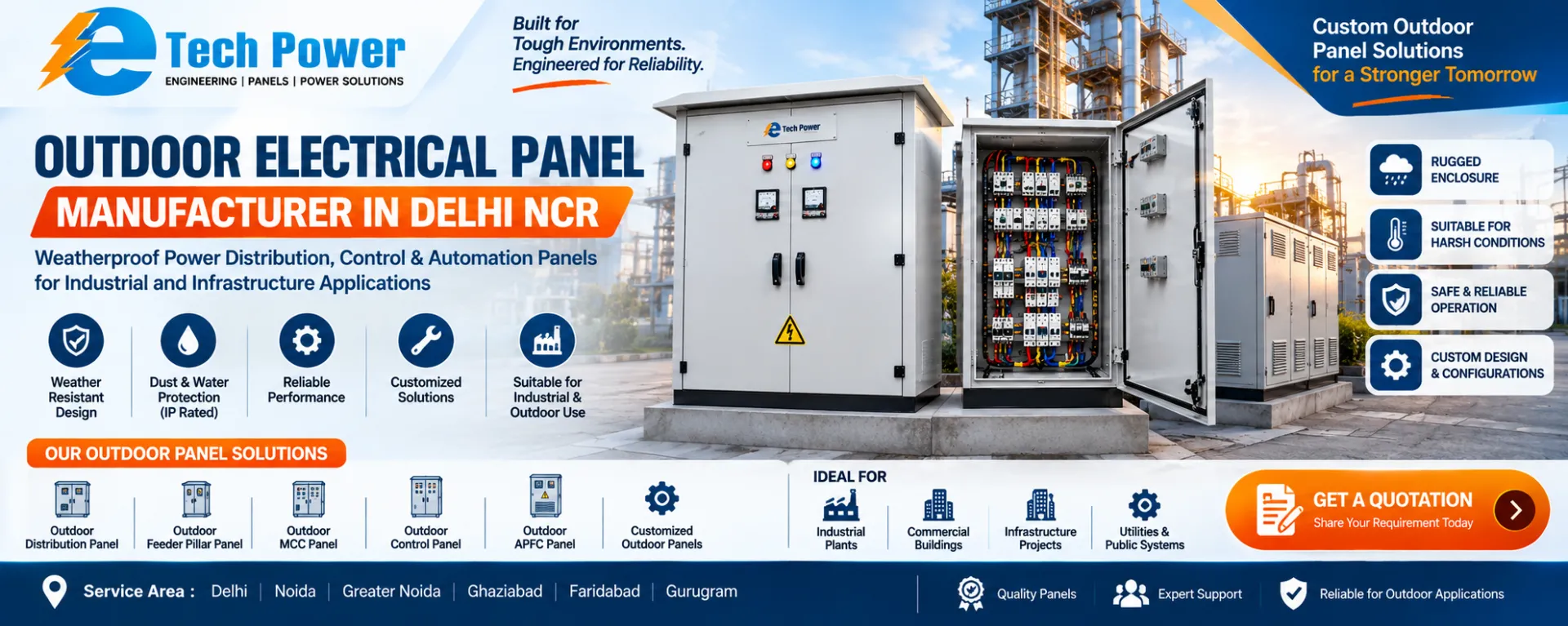
Weather-resistant power distribution, feeder, MCC and control panels for outdoor electrical installations
E-Tech Power manufactures customized Outdoor Electrical Panels for industrial, commercial, infrastructure and utility applications where electrical equipment needs to operate in an outdoor or exposed environment.
Our outdoor panel solutions can be designed for power distribution, motor control, feeder protection, automation, metering and electrical equipment isolation, depending on the application.
Unlike a standard indoor panel, an outdoor electrical panel needs to be designed around environmental conditions such as rain, dust, humidity, temperature, sunlight, accidental water exposure and corrosion risk in addition to the electrical load and protection requirements.
The enclosure, doors, sealing arrangement, cable entry, ventilation, cooling and electrical components are therefore selected according to the actual installation conditions.
E-Tech Power provides customized outdoor electrical panel solutions for projects across Delhi NCR, Noida, Greater Noida, Ghaziabad, Faridabad and Gurugram.
What Is an Outdoor Electrical Panel?
An Outdoor Electrical Panel is an electrical enclosure and assembly designed to house power distribution, protection, switching, control or automation equipment in an outdoor or environmentally exposed location.
Depending on its application, an outdoor panel may contain:
- MCCB
- ACB
- MCB
- Contactors
- Motor starters
- Busbars
- Energy meters
- Multifunction meters
- Protection relays
- Control relays
- PLC
- HMI
- VFD
- APFC equipment
- Terminal blocks
- Control components
The enclosure is selected to provide an appropriate level of protection against dust, water and environmental exposure based on the required installation conditions.
In simple terms:
Electrical Load + Protection + Control Equipment + Suitable Outdoor Enclosure = Outdoor Electrical Panel
The exact construction depends on the application, electrical rating and environmental requirements.
Why Is an Outdoor Electrical Panel Different from an Indoor Panel?
An indoor electrical panel is normally installed in a controlled environment. An outdoor panel may be exposed to rain, dust, humidity, temperature variations and sunlight.
Therefore, outdoor panel design requires additional consideration for:
- Water ingress
- Dust ingress
- Corrosion
- Heat dissipation
- Condensation
- UV exposure
- Cable entry sealing
- Door sealing
- Ventilation
- Accessibility
- Maintenance
- Mechanical protection
The correct enclosure and protection level should be selected according to the actual site environment rather than simply choosing a higher IP rating.
Types of Outdoor Electrical Panels
E-Tech Power can manufacture different types of outdoor electrical panels according to project requirements.
Outdoor Distribution Panel
An Outdoor Distribution Panel is used to distribute electrical power to multiple downstream feeders or loads.
It can be configured with:
- Incoming breaker
- Busbar system
- Outgoing MCCBs/MCBs
- Metering
- Protection
- Indication
- Cable termination
- Surge protection where required
These panels are commonly used in industrial facilities, commercial premises, infrastructure projects and utility installations.
Outdoor Feeder Pillar Panel
An Outdoor Feeder Pillar Panel is generally used for electrical distribution where multiple outgoing feeders need to be controlled and protected from a suitable outdoor enclosure.
Depending on the project, a feeder pillar can incorporate:
- Incoming supply
- Busbars
- Multiple outgoing feeders
- MCCBs
- MCBs
- Metering
- Cable termination
- Street-lighting controls
- Timer/contactors
- Protection devices
Feeder pillars are frequently used for industrial areas, infrastructure projects, street lighting, utility distribution and outdoor electrical networks.
Outdoor MCC Panel
An Outdoor Motor Control Centre (MCC) is designed for controlling and protecting multiple motor-driven loads.
An outdoor MCC can be configured with:
- Motor feeders
- DOL starters
- Star-delta starters
- Soft starters
- VFDs
- MCCBs
- Contactors
- Overload protection
- Control relays
- PLC-based control
- Local/remote operation
The enclosure and thermal management should be designed according to the outdoor installation environment and the heat generated by the installed equipment.
Outdoor Control Panel
Outdoor control panels are used for electrical and automation control applications where the control equipment needs to be installed outside the main electrical room.
Depending on the requirement, the panel can include:
- PLC
- HMI
- Relays
- Timers
- Control switches
- Indication lamps
- Sensors/interface terminals
- Communication devices
- Control transformers or SMPS
Outdoor APFC Panel
An Outdoor APFC Panel is designed for automatic power factor correction in installations where the capacitor bank and associated control equipment need to be located outdoors.
An outdoor APFC panel may include:
- APFC relay
- Capacitor banks
- Capacitor-duty contactors
- MCCB
- Detuned reactors where required
- Harmonic-related provisions where applicable
- Cooling/ventilation arrangement
- Metering
The capacitor selection and APFC configuration should be based on the actual load profile and electrical system.
Outdoor LT Panel
Outdoor LT panels can be designed for low-voltage power distribution and control applications.
Depending on the requirement, they may include:
- ACB
- MCCB
- Busbars
- Metering
- Protection
- Outgoing feeders
- Control circuits
- Cable termination
The panel rating and short-circuit withstand requirements should be finalized according to the electrical design.
Customized Outdoor Electrical Panel
If your requirement does not fit a standard panel configuration, E-Tech Power can develop a customized solution according to:
- Load requirement
- Current rating
- Voltage
- Number of feeders
- Equipment arrangement
- Protection requirements
- Automation requirements
- Site conditions
- Cable entry
- Mounting arrangement
- Enclosure requirements
IP Rating for Outdoor Electrical Panels
IP rating is an important consideration when selecting an outdoor electrical enclosure.
The required IP protection level depends on the expected exposure to dust and water.
For example, an installation exposed to rain and dust may require a different enclosure configuration from a panel installed under a protected outdoor shed.
Possible configurations may include:
IP54 | IP55 | IP65 | IP66
Only list the IP ratings that E-Tech Power actually manufactures or supplies.
The required IP rating should be determined according to:
- Outdoor exposure
- Rain and water spray
- Dust conditions
- Cleaning method
- Installation location
- Cable entry arrangement
- Door sealing
- Gland plate design
- Maintenance requirements
A higher IP number is not automatically the best choice for every application.
Outdoor Electrical Panel Enclosure Construction
The enclosure material can be selected according to the application and environmental conditions.
Possible options include:
Powder-Coated Mild Steel
Suitable for many general industrial and commercial applications when an appropriate coating system is selected.
Stainless Steel
Can be considered for applications where increased corrosion resistance or hygienic/environmental requirements justify its use.
Customized Enclosure
Material, thickness, coating, mounting arrangement and construction can be customized according to the project.
Weather Protection for Outdoor Panels
An outdoor electrical panel should be designed as a complete system rather than simply placing an indoor panel outside.
Important design considerations include:
Sealed Doors
Proper door sealing helps reduce unwanted entry of dust and water.
Cable Gland Arrangement
Cable entries should be designed and sealed appropriately for the selected enclosure and installation.
Rain Protection
Where required, a suitable canopy, sloping top or other construction can be considered according to the site conditions.
Ventilation
Outdoor panels containing heat-generating equipment may require suitable ventilation or thermal management.
Anti-Condensation Measures
For certain installations, condensation can become a concern due to temperature and humidity changes. Suitable heaters or other measures may be considered where required.
Corrosion Consideration
Material, coating and surface treatment should be selected according to humidity, chemical exposure and other environmental conditions.
Electrical Protection in Outdoor Panels
Outdoor location does not change the fundamental need for electrical protection.
Depending on the application, suitable protection may include:
- Short-circuit protection
- Overload protection
- Over-current protection
- Earth-fault protection
- Under-voltage protection
- Over-voltage protection
- Phase-failure protection
- Surge protection
- Motor protection
The actual protection arrangement should be selected according to the connected load and approved electrical design.
Outdoor Panel Cooling and Ventilation
Heat management becomes particularly important when outdoor panels contain equipment such as:
- VFDs
- Soft starters
- Transformers
- APFC capacitor banks
- Power electronics
- High-current switching devices
The enclosure design may therefore require:
- Natural ventilation
- Filtered ventilation
- Cooling fans
- Air-conditioning
- Heat exchangers
- Thermal monitoring
The appropriate solution depends on the heat load, ambient temperature, enclosure construction and installation conditions.
Applications of Outdoor Electrical Panels
Outdoor electrical panels are used across a wide range of industrial and infrastructure applications.
Manufacturing Plants
For outdoor power distribution, motors, pumps and auxiliary electrical systems.
Water Treatment Plants
For pumps, motors, blowers, control systems and electrical distribution.
STP and ETP Projects
For sewage and effluent treatment equipment requiring outdoor electrical control and distribution.
Pumping Stations
For pump control, motor protection and electrical distribution.
HVAC & Cooling Systems
For outdoor mechanical and electrical equipment.
Infrastructure Projects
For electrical distribution and control in infrastructure installations.
Industrial Utilities
For compressors, pumps, cooling systems and auxiliary plant equipment.
Warehouses & Logistics Facilities
For outdoor feeders, pumps, lighting and other electrical loads.
Commercial Buildings
For selected outdoor distribution and building-services applications.
Street Lighting & Utility Systems
For feeder pillar and lighting-control applications where suitable outdoor enclosures are required.
Benefits of a Properly Designed Outdoor Electrical Panel
Environmental Protection
A suitable enclosure helps protect electrical components from the expected outdoor environment.
Improved Equipment Reliability
Appropriate enclosure, cooling and component selection can support reliable operation.
Safer Electrical Distribution
Proper protection and isolation arrangements help manage electrical faults and maintenance requirements.
Reduced Maintenance Problems
Correct sealing, cable entry and thermal management can help reduce environmental-related problems.
Application-Specific Design
The panel can be designed around the actual load, equipment and installation conditions.
Easy Maintenance
Proper internal layout, identification and accessibility can make inspection and maintenance easier.
How to Select the Right Outdoor Electrical Panel?
Selecting an outdoor panel should start with the electrical requirement and site environment.
1. Determine the Electrical Load
Provide:
- Connected load
- Maximum demand
- Current rating
- Motor load, if applicable
2. Confirm the Supply
Specify:
- Voltage
- Frequency
- Number of phases
- Neutral requirement
- Earthing arrangement
3. Identify the Panel Application
For example:
- Distribution
- Feeder pillar
- MCC
- APFC
- Automation
- Motor control
- Pump control
4. Evaluate the Environment
Consider:
- Rain exposure
- Dust
- Humidity
- Ambient temperature
- Chemical exposure
- Corrosive atmosphere
- Direct sunlight
5. Select the Enclosure
The enclosure material, construction and IP rating should be selected based on the site conditions.
6. Define Protection
Specify required protection such as:
- MCCB/ACB
- Overload
- Short circuit
- Earth fault
- Surge protection
- Voltage protection
- Motor protection
7. Consider Heat Dissipation
If the panel contains VFDs, APFC capacitors or other heat-producing equipment, thermal management should be included in the design.
Outdoor Electrical Panel Technical Specifications
The final specification should be customized according to the project.
| Parameter | Typical Configuration |
|---|---|
| Application | Distribution / MCC / Feeder / Control / APFC |
| System | LT Electrical System |
| Voltage | As per project requirement |
| Frequency | As per project requirement |
| Current Rating | Customized |
| Incomer | MCCB / ACB / As specified |
| Outgoings | MCCB / MCB / As specified |
| Busbar | Copper / Aluminium as specified |
| Enclosure | MS / SS / As specified |
| IP Rating | As required by installation |
| Metering | Optional |
| Protection | As required |
| Ventilation | Natural / Forced / Cooling system |
| Cable Entry | Top / Bottom / Customized |
| Mounting | Floor Mounted / Plinth Mounted / Customized |
| Automation | Optional |
| PLC/HMI | Optional |
| Customization | Available |
Final ratings and specifications should be confirmed from the approved electrical design.
Outdoor Electrical Panel Manufacturing Process
At E-Tech Power, the panel manufacturing process can be organized around the project’s electrical and mechanical requirements.
Requirement Analysis
We understand the load, application, source, environment and required control functions.
Electrical Design
The electrical arrangement, protection and control philosophy are developed according to the requirement.
Component Selection
Switchgear, protection, metering and control components are selected according to the project specification.
Enclosure Fabrication
The enclosure is fabricated according to the required dimensions, mounting arrangement and environmental conditions.
Busbar & Component Assembly
Switchgear, busbars, control components and accessories are assembled according to the approved design.
Wiring
Power and control circuits are wired and properly identified.
Inspection & Functional Testing
The completed panel can undergo appropriate inspection and testing, which may include:
- Visual inspection
- Wiring verification
- Continuity checks
- Insulation checks where applicable
- Functional testing
- Interlock verification
- Meter/indication verification
- Control circuit testing
Testing requirements should be finalized according to the project and applicable standards.
Outdoor Electrical Panel Manufacturer in Delhi NCR
E-Tech Power manufactures customized outdoor electrical panel solutions for industrial and commercial requirements in Delhi NCR.
Our service area includes:
Delhi | Noida | Greater Noida | Ghaziabad | Faridabad | Gurugram
We can also evaluate requirements from nearby industrial areas and other locations based on project scope and service availability.
If you need an Outdoor Electrical Panel Manufacturer in Delhi NCR, share your load details and application with our team.
Outdoor Electrical Panel Manufacturer in Noida
For industrial and commercial installations in Noida, E-Tech Power can provide customized outdoor distribution, feeder, MCC and control panel solutions.
Panel construction can be selected according to the electrical load and outdoor installation environment.
Outdoor Electrical Panel Manufacturer in Greater Noida
For manufacturing units, warehouses, industrial facilities and infrastructure projects in Greater Noida, customized outdoor electrical panels can be designed according to project requirements.
Outdoor Electrical Panel Manufacturer in Ghaziabad
E-Tech Power provides customized electrical panel solutions for industrial and commercial applications in Ghaziabad and nearby areas.
Outdoor Electrical Panel Manufacturer in Faridabad
Outdoor distribution, motor-control and feeder-panel solutions can be configured for industrial applications in Faridabad according to electrical and environmental requirements.
Outdoor Electrical Panel Manufacturer in Gurugram
For commercial buildings, industrial facilities and infrastructure projects in Gurugram, outdoor electrical panels can be customized for distribution, motor control and other electrical applications.
Why Choose E-Tech Power?
Customized Engineering
We design panels according to the electrical application rather than using a single standard configuration.
Electrical & Automation Solutions
Depending on the project, electrical protection and automation functions can be integrated into the same panel solution.
Environment-Focused Design
Outdoor enclosure selection considers the actual installation environment, including dust, water exposure, humidity and heat.
Flexible Configuration
Panel size, current rating, components, feeders, cable entry and control functions can be customized.
Quality Components
Components can be selected according to customer specifications and project requirements.
Testing & Inspection
Panels can be inspected and functionally tested according to the specified design and applicable requirements.
Technical Support
- Installation support
- Commissioning
- Troubleshooting
- Maintenance
- Technical consultation
Outdoor Electrical Panel Price
The price of an outdoor electrical panel depends on its electrical rating, enclosure construction and installed equipment.
Major cost factors include:
- Current rating
- Voltage
- MCCB/ACB selection
- Number of feeders
- Busbar rating
- Enclosure material
- IP rating
- Metering
- Protection devices
- VFDs
- APFC components
- PLC/HMI
- Cooling arrangement
- Cable entry
- Quantity
- Installation requirements
Therefore, there is no single standard price for an outdoor electrical panel.
Frequently Asked Questions
What is an Outdoor Electrical Panel?
An Outdoor Electrical Panel is an electrical assembly designed to house switching, distribution, protection, control or automation equipment in an outdoor or environmentally exposed location.
What is the difference between an indoor and outdoor electrical panel?
An outdoor panel requires additional consideration for environmental exposure such as rain, dust, humidity, temperature variation, corrosion and condensation. The enclosure and thermal management are selected accordingly.
Which IP rating is suitable for an outdoor electrical panel?
There is no single IP rating suitable for every outdoor application. The required rating depends on exposure to dust and water, installation location and operating conditions.
Can an outdoor electrical panel be installed in direct rain?
It can be designed for exposed outdoor installation when the enclosure, sealing, cable entries, drainage and other construction details are appropriate for the intended environmental conditions.
What material is used for outdoor electrical panels?
Mild steel with a suitable coating and stainless steel are common options. Material selection depends on environmental exposure, corrosion conditions and project requirements.
Can an outdoor panel include MCCB and ACB?
Yes. MCCBs and ACBs can be incorporated according to the required current rating, fault level, protection arrangement and electrical design.
Can an outdoor MCC panel be manufactured?
Yes. Outdoor MCC panels can be designed for multiple motor feeders with suitable motor starters, protection and control arrangements.
Can VFDs be installed in an outdoor panel?
Yes, but VFD-based outdoor panels require appropriate thermal management and enclosure design because VFDs generate heat during operation.
Can PLC and HMI be integrated?
Yes. PLC and HMI can be incorporated where automation, monitoring and programmable control are required.
Can an outdoor APFC panel be manufactured?
Yes. APFC panels can be designed for outdoor installation with suitable capacitor banks, switching devices, protection and thermal management.
How much does an outdoor electrical panel cost?
The price depends on current rating, enclosure material, IP requirement, switchgear, feeders, metering, protection, automation and other project specifications. A project-specific quotation is recommended.
What information is required for quotation?
Provide the panel type, load/current rating, voltage, number of feeders, application, quantity and installation location. An SLD or load schedule is also helpful.