

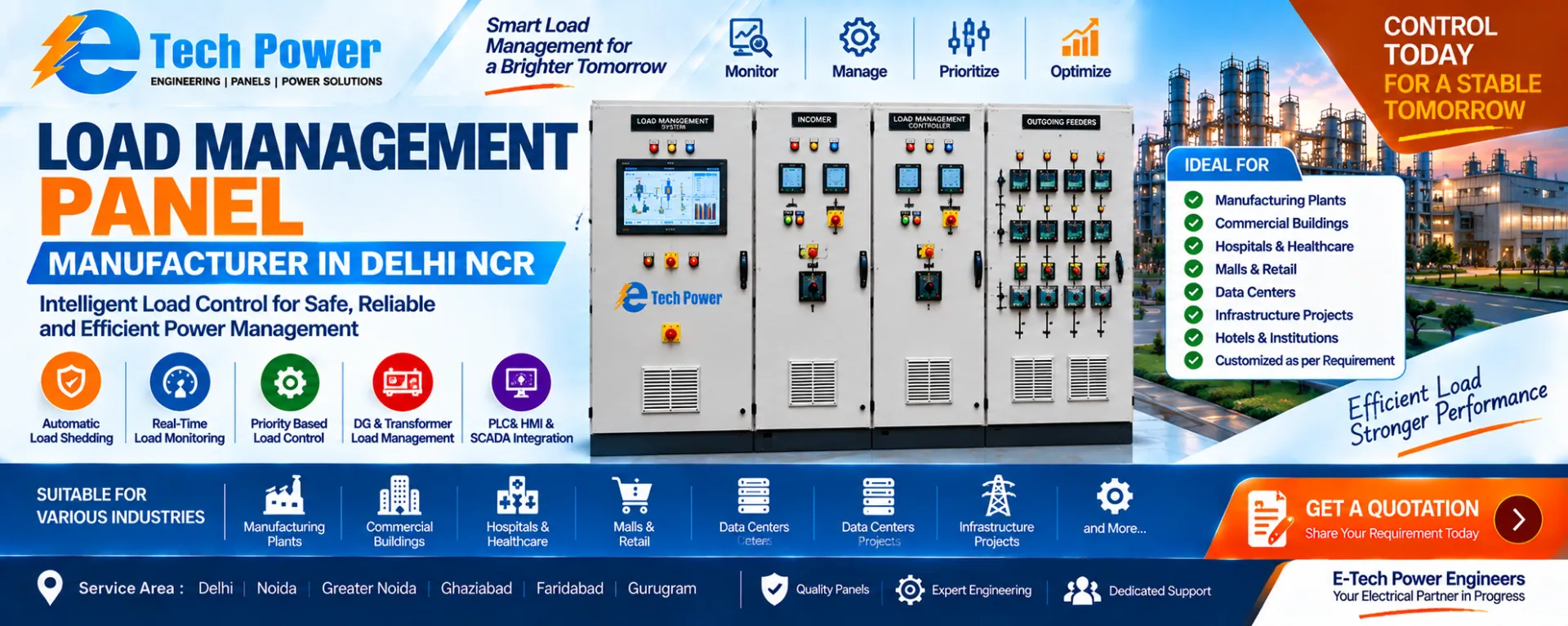
E-Tech Power Engineers is a Load Management Panel Manufacturer in Delhi NCR, providing customized electrical load monitoring, load shedding, demand control and power management solutions for industrial, commercial and infrastructure applications.
A Load Management Panel monitors electrical demand and controls selected loads according to predefined priorities and available power capacity. It can be integrated with PLCs, HMIs, energy meters, power analyzers, generator controls and other electrical systems depending on project requirements.
Load management is particularly useful where the available transformer, DG capacity or electrical infrastructure needs to be managed carefully during high-demand conditions.
What Is a Load Management Panel?
A Load Management Panel is an electrical control and automation panel used to monitor electrical loads and automatically control selected circuits according to predefined operating conditions.
The system can identify when electrical demand approaches a configured limit and, depending on the control philosophy, disconnect selected non-critical loads. Loads can subsequently be restored when adequate capacity becomes available.
The objective is to keep electrical demand within the available system capacity while maintaining priority loads.
How Does a Load Management Panel Work?
A typical load management system follows this sequence:
Measure → Compare → Prioritize → Shed → Monitor → Restore
The system measures electrical parameters through suitable metering devices or current/voltage sensing arrangements.
The controller compares the measured demand with predefined thresholds.
Loads are assigned priorities such as:
- Critical loads
- Essential loads
- Non-essential loads
If the configured demand limit is reached, selected non-critical loads can be disconnected according to the programmed sequence.
When sufficient capacity becomes available, the restoration logic can reconnect selected loads according to the programmed strategy.
The exact sequence, delay times and priority logic are customized according to the application.
Main Functions of a Load Management Panel
A Load Management Panel can be designed for:
- Load monitoring
- Automatic load shedding
- Load prioritization
- Demand limit control
- Peak demand management
- Generator load management
- Transformer capacity management
- Feeder control
- Load restoration
- Energy monitoring
- Alarm generation
- HMI monitoring
- PLC-based control
- SCADA integration
- Remote monitoring, where required
Not every function is required in every installation. The final configuration depends on the project’s electrical architecture and control philosophy.
Why Is Load Management Important?
Electrical systems can experience high demand when several large loads operate simultaneously.
Excessive demand can result in:
- Transformer overloading
- DG overloading
- Feeder overloading
- Increased peak demand
- Voltage-related operating problems
- Unnecessary tripping
- Reduced available electrical capacity
- Higher demand-related electricity costs where applicable
A load management system helps control these situations by automatically managing selected loads according to their priority.
It should not be considered a replacement for correctly sized electrical infrastructure; rather, it is a control strategy that helps manage available capacity.
Automatic Load Shedding
Automatic load shedding is one of the primary functions of a load management system.
For example, a facility may classify loads as:
Priority 1: Critical loads
Priority 2: Essential loads
Priority 3: Non-essential loads
If available power capacity becomes insufficient, the system can disconnect selected lower-priority loads first.
This allows critical loads to remain prioritized while reducing the electrical demand on the source.
Generator Load Management
Load management becomes particularly useful when electrical loads are supplied from diesel generators.
A DG load management system can monitor generator loading and initiate predefined load-shedding sequences when the generator approaches its configured operating limit.
Possible applications include:
- Hospitals
- Hotels
- Manufacturing facilities
- Commercial buildings
- Construction sites
- Infrastructure projects
- Industrial plants
The actual generator control strategy must be coordinated with the DG controller and generator manufacturer’s recommendations.
Load Management Panel with PLC
A PLC can be used as the central control device for customized load management applications.
A typical architecture may include:
Energy Meter / Power Analyzer → PLC → Control Logic → Contactors/Breakers → Loads
The PLC can process measured values and execute programmed load-shedding or restoration sequences.
PLC-based systems can also provide:
- Alarm handling
- Status monitoring
- Event logging
- Interlocks
- Timer-based control
- Communication
- HMI integration
- SCADA integration
The exact PLC and communication architecture should be selected according to project requirements.
Load Management Panel with HMI
An HMI provides an operator interface for viewing system status and electrical parameters.
Depending on the configuration, the HMI can display:
- Incoming voltage
- Current
- Frequency
- kW
- kVA
- Power factor
- Demand
- Feeder status
- Load status
- DG status
- Load-shedding status
- Alarm conditions
- Trip indications
An HMI can also allow authorized operators to view or modify selected control parameters where the system design permits.
Smart Load Management System
For projects requiring more advanced monitoring, the Load Management Panel can be integrated with energy meters, power analyzers and communication systems.
Possible features include:
- Real-time energy monitoring
- Demand monitoring
- Historical data
- Alarm logging
- Load status monitoring
- Energy consumption analysis
- Communication with SCADA/BMS
- Remote monitoring
Advanced analytics and reporting depend on the selected meters, software, PLC/SCADA architecture and communication infrastructure.
Types of Load Management Panels
Automatic Load Management Panel
Designed for automatic monitoring and control of electrical loads based on predefined thresholds and priorities.
DG Load Management Panel
Designed to manage selected loads when operating on generator power and help prevent excessive DG loading.
PLC-Based Load Management Panel
Uses PLC-based control logic for customized load-shedding, restoration and monitoring applications.
Energy Monitoring and Load Management Panel
Combines electrical energy monitoring with load control functions.
SCADA-Integrated Load Management Panel
Can communicate with a higher-level SCADA system for centralized monitoring where required.
Customized Load Shedding Panel
Designed around a specific facility’s load priorities, feeder arrangement and operating sequence.
Main Components of a Load Management Panel
Typical components may include:
- PLC
- HMI
- Multifunction energy meter
- Power analyzer
- Current transformers
- MCCB
- Contactors
- Control relays
- Auxiliary relays
- SMPS/DC power supply
- Communication modules
- Terminal blocks
- Indication lamps
- Selector switches
- Busbars
- Control wiring
- Protection devices
The actual component list depends on the required control method and electrical ratings.
Protection and Interlocking
Protection and interlocking are important for safe operation.
Depending on the system, the panel can incorporate:
- Overload protection
- Short-circuit protection
- Earth-fault protection
- Over/under-voltage monitoring
- Phase-failure monitoring
- Breaker status monitoring
- DG overload monitoring
- Transformer loading monitoring
- Communication failure alarms
- Electrical and control interlocks
Load management should complement, not replace, the primary protection system of the electrical installation.
Load Management for Transformer Capacity
In facilities with limited transformer capacity, load management can be used to control selected non-critical loads during high-demand conditions.
For example, a facility may temporarily disconnect:
- HVAC loads
- Water pumping systems
- Utility equipment
- Battery charging loads
- Selected production equipment
- Other non-critical feeders
The actual load priority should be decided by the facility operator and electrical design team.
Load Management for DG Systems
When multiple or single DG sets supply a facility, the load management system can be coordinated with generator operation.
Depending on the design, it may:
- Monitor DG loading.
- Compare demand against a configured limit.
- Identify lower-priority loads.
- Shed selected loads.
- Generate an alarm.
- Restore loads when capacity becomes available.
For multi-DG systems, load management can also be coordinated with synchronization and load-sharing systems where the required controls are available.
Load Management vs Load Shedding
These terms are related but are not exactly the same.
| Load Management | Load Shedding |
|---|---|
| Broader power-management strategy | Specific method of disconnecting selected loads |
| Monitors demand and available capacity | Removes selected loads when required |
| Can include monitoring and restoration | Primarily focuses on reducing demand |
| Can use PLC/HMI/SCADA | Can be automatic or controlled |
| May include DG/transformer management | Usually priority-based disconnection |
This distinction is useful when specifying a control system for a project.
Load Management Panel Applications
Load Management Panels can be used in:
- Manufacturing plants
- Industrial facilities
- Commercial buildings
- Warehouses
- Hotels
- Hospitals
- Educational institutions
- Shopping complexes
- Data centres
- Water treatment facilities
- Infrastructure projects
- Utility installations
The control philosophy should be customized according to the facility’s electrical load profile.
Benefits of Load Management Panels
A properly designed load management system can help:
- Prevent excessive loading
- Prioritize critical electrical loads
- Manage available transformer capacity
- Manage generator loading
- Reduce unnecessary peak demand where applicable
- Improve visibility of electrical consumption
- Automate load-shedding sequences
- Reduce manual intervention
- Improve operational control
Cost savings are application-dependent and should not be guaranteed without analysing the facility’s tariff structure, demand profile and existing electrical system.
Load Management Panel Technical Specifications
| Parameter | Configuration |
|---|---|
| Application | Load Monitoring & Control |
| Control | PLC / Relay Logic as required |
| Display | HMI / Digital Meter |
| Monitoring | V, A, kW, kVA, PF, Frequency |
| Load Shedding | Automatic / Manual as required |
| Load Restoration | Programmable |
| Communication | As required |
| SCADA | Optional |
| DG Integration | Optional |
| Installation | Indoor / Outdoor as required |
| Enclosure | Customized |
| Feeders | As per load schedule |
| Protection | As per approved design |
Actual electrical ratings should be finalized from the project load schedule, fault level, source capacity and approved SLD.
How to Select a Load Management Panel
Before ordering a Load Management Panel, provide:
- Connected load
- Maximum demand
- Transformer rating
- DG rating
- Number of feeders
- Critical-load details
- Essential-load details
- Non-essential-load details
- Load-shedding sequence
- Restoration sequence
- Required demand threshold
- Metering requirements
- PLC/HMI requirement
- SCADA/BMS requirement
- Communication protocol
- Indoor/outdoor installation requirement
The load schedule and Single Line Diagram (SLD) are particularly useful for developing the correct control logic.
Manufacturing Process
A typical project workflow includes:
Requirement Analysis → Load Study → Electrical & Control Design → Component Selection → Panel Fabrication → Assembly → Wiring → PLC/HMI Programming → Inspection → Functional Testing → Delivery/Commissioning
The final process depends on the scope of supply and project requirements.
Testing of Load Management Panels
Testing should be based on the approved design and agreed project scope.
Possible checks include:
- Visual inspection
- Wiring verification
- Continuity checks
- Insulation resistance testing
- Meter verification
- PLC I/O verification
- HMI functionality
- Load-shedding sequence verification
- Load-restoration sequence verification
- Interlock verification
- Communication testing
- Alarm testing
Actual testing claims should correspond to the testing facilities and procedures used for the supplied panel.
Load Management Panel Price in Delhi NCR
The price depends on:
- Number of feeders
- Load capacity
- PLC selection
- HMI size
- Energy meters
- Power analyzers
- Breaker/contactors
- Communication requirements
- DG integration
- SCADA integration
- Panel dimensions
- Control complexity
- Installation and commissioning requirements
Therefore, a fixed price cannot be accurately quoted from the product name alone.
For an accurate quotation, share your SLD, load schedule, transformer/DG rating and required load-shedding sequence.
Load Management Panel Manufacturer in Noida, Greater Noida & Ghaziabad
E-Tech Power Engineers is located at Plot No. 91, Udyog Kendra-II, Ecotech-III, Greater Noida – 201306. The company’s website lists Load Management Panels among its specialized panel solutions and provides service coverage across Delhi NCR.
Service areas include:
- Delhi
- Noida
- Greater Noida
- Ghaziabad
- Faridabad
- Gurugram
- Manesar
- Sonipat
- Bhiwadi
- Neemrana
Actual installation and commissioning availability should be confirmed according to the project scope and location.
Why Choose E-Tech Power Engineers?
For a load management project, the important consideration is not only the panel enclosure but the complete electrical control philosophy.
The solution should be based on:
- Actual load profile
- Available transformer/DG capacity
- Load priorities
- Feeder configuration
- Protection requirements
- Control sequence
- Metering requirements
- PLC/HMI requirements
- Communication requirements
E-Tech Power Engineers provides customized electrical panel solutions and lists PLC, LT, MCC, PCC, AMF and other panels within its product portfolio.
Frequently Asked Questions
What is a Load Management Panel?
A Load Management Panel is an electrical control system that monitors electrical demand and controls selected loads according to predefined capacity and priority settings.
What is automatic load shedding?
Automatic load shedding is the controlled disconnection of selected lower-priority loads when electrical demand exceeds a configured limit.
Can a Load Management Panel prevent DG overloading?
It can help manage DG loading by monitoring generator demand and disconnecting selected loads according to a predefined load-shedding strategy.
Can PLC be used in a Load Management Panel?
Yes. PLC-based control is suitable for customized load-shedding, load-restoration, monitoring, alarms and communication functions.
Can HMI be integrated?
Yes. HMI can be used to display electrical parameters, feeder status, alarms, load-shedding status and other system information.
Can it be integrated with SCADA?
Yes, SCADA integration can be provided where the required communication hardware, protocol and software architecture are included.
Can it control transformer loading?
A suitably designed system can monitor transformer loading and control selected loads when predefined limits are reached.
Does load management always reduce electricity bills?
Not necessarily. Savings depend on the site’s load profile, tariff structure, maximum-demand charges and how the control system is implemented.
What information is required for quotation?
The best starting information is the electrical SLD, load schedule, transformer/DG rating, feeder list and required load priorities.
Get a Load Management Panel Quotation
Looking for a Load Management Panel Manufacturer in Delhi NCR?
Share your SLD, load schedule, transformer/DG capacity and load-shedding requirements with E-Tech Power Engineers for a customized solution.