

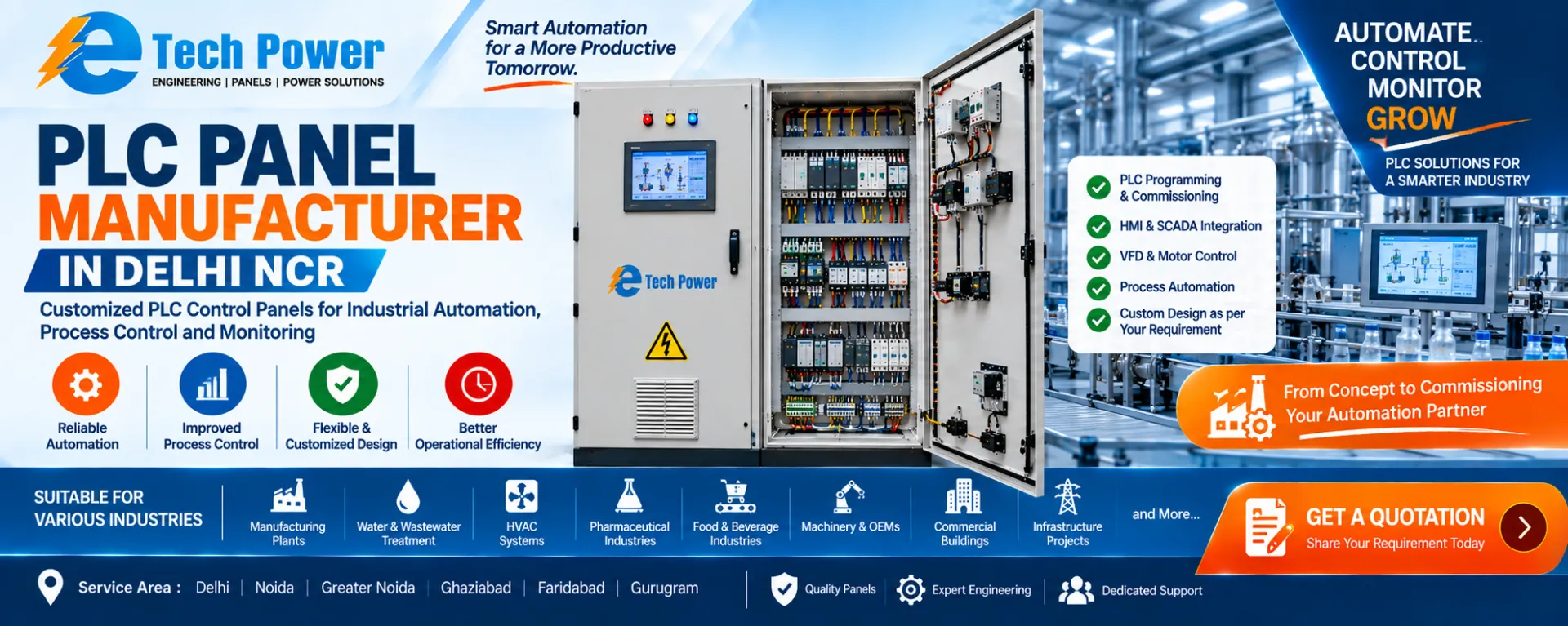
Customized PLC Control Panels for Industrial Automation, Process Control, Motor Control and Monitoring
E-Tech Power manufactures PLC Control Panels and Industrial Automation Panels for industrial applications requiring automatic control, process sequencing, equipment monitoring and centralized operation.
A PLC panel combines a Programmable Logic Controller (PLC) with the required power supply, input/output modules, relays, terminal blocks, communication devices and control components to execute a defined automation process.
Depending on the project, the panel can also integrate HMI, VFDs, soft starters, remote I/O, industrial communication, SCADA interfaces and field instrumentation.
Our PLC panels are engineered according to the actual application, including I/O requirements, motor loads, control philosophy, process sequence, communication architecture and future expansion requirements.
E-Tech Power serves industrial and commercial customers across Delhi, Noida, Greater Noida, Ghaziabad, Faridabad and Gurugram.
What Is a PLC Panel?
A PLC Panel is an electrical control panel containing a Programmable Logic Controller and associated equipment used to automate machines, processes and industrial systems.
The PLC receives signals from field devices, processes those signals according to programmed logic and generates output commands for connected equipment.
A typical system may operate as:
Sensors / Field Devices → PLC → Control Logic → Output Devices → Machine / Process
The actual architecture depends on the application.
A PLC panel may control:
- Motors
- Pumps
- Fans
- Blowers
- Conveyors
- Valves
- Actuators
- VFDs
- Soft starters
- Heating systems
- Process equipment
- Alarm systems
How Does a PLC Control Panel Work?
A PLC-based control system generally works through four stages.
1. Input Signals
Sensors and field devices provide information to the PLC.
Typical inputs include:
- Push buttons
- Limit switches
- Proximity sensors
- Pressure switches
- Level switches
- Temperature sensors
- Flow transmitters
- Pressure transmitters
- Motor feedback
- Emergency signals
2. PLC Processing
The PLC CPU evaluates the input signals according to the programmed control logic.
For example, the PLC may determine whether a pump should start when:
- Tank level reaches a defined point
- Required interlocks are healthy
- No fault is present
- The system is in automatic mode
3. Output Control
The PLC sends commands to the relevant equipment.
For example:
PLC → Relay → Contactor → Motor
or:
PLC → Control Signal → VFD → Motor
4. Monitoring
An HMI or SCADA system can display equipment status, process values, alarms and other information when included in the project.
PLC Panel vs Conventional Control Panel
Conventional control systems may rely heavily on hardwired relays, timers and contactors.
A PLC-based system uses programmable logic, making it particularly useful where the control sequence is complex or may need modification.
| Feature | Conventional Control | PLC Control |
|---|---|---|
| Control logic | Mainly hardwired | Programmable |
| Logic modification | Wiring changes may be required | Program modification possible |
| Complex sequencing | More wiring | Easier to manage |
| Diagnostics | Relatively limited | PLC diagnostics available |
| HMI integration | Possible | Common |
| SCADA integration | Possible | Common |
| Expansion | Wiring dependent | I/O and architecture dependent |
For a simple application, conventional control may still be an economical solution. PLC should be selected where its automation and control capabilities provide a practical benefit.
Types of PLC Panels
PLC Automation Panel
A PLC Automation Panel is designed to control automated machines and industrial processes according to programmed sequences.
Typical applications include:
- Production machines
- Packaging machines
- Conveyor systems
- Material handling
- Automated machinery
- Industrial utility systems
PLC VFD Panel
A PLC VFD Panel combines PLC automation with Variable Frequency Drives.
The PLC can provide start/stop and speed commands to the VFD and can receive operating or fault feedback from the drive.
Typical applications include:
- Pumps
- Fans
- Blowers
- Conveyors
- Compressors
- HVAC systems
- Process machinery
Depending on the selected equipment, communication can be achieved using digital/analog signals or an industrial communication protocol.
PLC SCADA Panel
A PLC can be connected to a SCADA system for supervisory monitoring and control.
A typical architecture is:
Field Devices → PLC → Industrial Network → SCADA
SCADA integration can provide:
- Process visualization
- Alarm monitoring
- Equipment status
- Trend display
- Historical information
- Supervisory commands
- User access management
The actual functionality depends on the selected SCADA platform and project requirements.
Process Control PLC Panel
Process-control PLC panels are used where equipment must operate according to defined process conditions and sequences.
Applications may include:
- Water treatment
- Wastewater treatment
- Chemical processes
- Food processing
- Pharmaceutical processes
- Utility systems
- Manufacturing processes
PLC systems can process signals from instruments measuring:
- Flow
- Pressure
- Temperature
- Level
- Speed
- Other process parameters
PLC Control Panel with HMI
An HMI provides an operator interface between the automation system and the user.
Depending on the project, an HMI can display:
- Motor status
- Process values
- Alarm conditions
- Set points
- Fault information
- Manual/Auto controls
- Equipment status
- Trends
The HMI screen structure should be designed according to the actual process and operator requirements.
Customized PLC Panel
Every automation project has different requirements.
A customized PLC panel can be designed according to:
- PLC make and model
- I/O count
- Digital inputs
- Digital outputs
- Analog inputs
- Analog outputs
- HMI requirement
- VFD quantity
- Soft starter requirement
- Communication protocol
- Remote I/O
- SCADA
- Field instruments
- Panel dimensions
- Cable entry arrangement
Main Components of a PLC Panel
A PLC panel can contain different components depending on the automation architecture.
PLC CPU
The PLC CPU executes the programmed control logic and manages communication with I/O modules and other devices.
Digital Input Modules
Digital inputs are used for ON/OFF signals such as:
- Push buttons
- Limit switches
- Proximity sensors
- Motor status
- Contactor feedback
- Emergency signals
Digital Output Modules
Digital outputs can operate devices such as:
- Relays
- Contactors
- Solenoid valves
- Indicator devices
- Other discrete control equipment
Analog Input Modules
Analog inputs are used for variable process signals such as:
- Temperature
- Pressure
- Flow
- Level
- Speed feedback
Common industrial signals include 4–20 mA and 0–10 V, depending on the instrumentation.
Analog Output Modules
Analog outputs can be used for variable control signals such as VFD speed references or control-valve commands where applicable.
24V DC Power Supply
A 24V DC power supply may provide control power for PLCs, sensors, relays and other DC control devices.
HMI
The HMI provides the operator interface for monitoring and controlling the process.
Communication Modules
Communication modules allow the PLC to exchange data with devices such as:
- VFDs
- Remote I/O
- HMI
- SCADA
- Energy meters
- Other automation equipment
Relays
Interposing relays may be used between PLC outputs and field equipment where required by the control architecture.
Circuit Protection
The panel may include appropriate MCBs, MCCBs, fuses and other protection devices according to the electrical design.
Terminal Blocks
Terminal blocks provide organized termination for field, power and control wiring.
PLC Panel Communication Options
Modern industrial automation systems can use different communication architectures.
Depending on the selected PLC and connected equipment, communication may include:
- Industrial Ethernet
- Modbus RTU
- Modbus TCP
- PROFINET
- PROFIBUS
- EtherNet/IP
- Other manufacturer-supported protocols
The communication protocol should be selected according to the PLC, VFD, HMI, SCADA and field devices used in the project.
PLC Panel for Motor Automation
PLC panels can control multiple motors according to programmed process sequences.
A simplified sequence can be:
Start Command
↓
PLC Checks Interlocks
↓
Motor Start Command
↓
Starter / VFD Operates
↓
Motor Running Feedback
↓
Next Process Step
This approach is useful when motors need to operate according to process conditions rather than simple manual ON/OFF operation.
PLC + VFD Automation
When variable motor speed is required, a PLC can control and monitor VFDs.
Depending on the system architecture, the PLC may provide:
- Start/Stop
- Speed reference
- Direction command
- Fault reset
- Run status
- Fault status
- Frequency feedback
- Current feedback
- Drive alarm information
Communication and available parameters depend on the selected VFD and communication architecture.
PLC Panel Applications
PLC control panels are suitable for a wide range of industrial automation applications.
Manufacturing Plants
PLC systems can control:
- Production machinery
- Conveyors
- Pumps
- Fans
- Compressors
- Material handling equipment
Water & Wastewater Treatment
PLC automation can coordinate:
- Raw-water pumps
- Transfer pumps
- Dosing systems
- Blowers
- Mixers
- Valves
- Filtration equipment
- Tank-level control
HVAC Systems
PLC-based control can be used for suitable HVAC and utility applications involving:
- Pumps
- Fans
- Cooling systems
- AHUs
- Chillers
- Cooling towers
Pharmaceutical Industry
PLC automation may be used for suitable:
- Process equipment
- Utility systems
- Pumps
- HVAC-related control
- Temperature monitoring
- Pressure monitoring
- Automated sequences
Project-specific validation and regulatory requirements should be established by the customer.
Food Processing Industry
PLC panels can be used for:
- Conveyors
- Pumps
- Mixing systems
- Filling systems
- Packaging equipment
- Temperature control
- Processing machinery
Chemical & Process Industries
PLC-based automation can be used for suitable process applications involving:
- Pumps
- Agitators
- Valves
- Flow control
- Level control
- Temperature monitoring
PLC Panel Technical Specifications
The final technical specification should always be prepared according to the project requirement.
| Parameter | Configuration |
|---|---|
| Panel Type | PLC / Automation / Process Control |
| PLC | As specified |
| Digital Inputs | As required |
| Digital Outputs | As required |
| Analog Inputs | As required |
| Analog Outputs | As required |
| HMI | Optional |
| SCADA | Optional |
| VFD | Optional |
| Soft Starter | Optional |
| Remote I/O | Optional |
| Communication | As required |
| Control Voltage | As specified |
| Power Supply | As required |
| Enclosure | Indoor / Outdoor as required |
| Cable Entry | Top / Bottom |
| Industrial Ethernet | Optional |
| Panel Mounting | Floor / Wall Mounted as required |
PLC Brands and Automation Platforms
The PLC platform should be selected according to the application, I/O requirements, communication architecture, existing plant standards, availability and customer preference.
Depending on actual project availability and approved BOM, PLC platforms may include:
- Siemens
- Schneider Electric
- Rockwell Automation / Allen-Bradley
- Mitsubishi Electric
- Omron
- Delta
- ABB
The final PLC make and model should be confirmed during technical discussions and quotation.
How to Select the Right PLC Panel?
A PLC panel should be designed according to the actual process rather than selecting the PLC first and adapting the process around it.
1. Prepare the I/O List
Identify:
- Digital Inputs
- Digital Outputs
- Analog Inputs
- Analog Outputs
2. Identify Field Instruments
List all sensors and instruments connected to the automation system.
3. Prepare the Motor List
Include:
- Motor rating
- Voltage
- Quantity
- Starting method
- VFD requirement
- Operating sequence
4. Define the Control Philosophy
Specify:
- Auto operation
- Manual operation
- Interlocks
- Sequence control
- Emergency conditions
- Alarm conditions
5. Define HMI Requirements
Determine which process parameters operators need to monitor and control.
6. Define SCADA Requirements
If centralized monitoring is required, define the required SCADA architecture and communication interface.
7. Consider Future Expansion
Where future expansion is expected, additional I/O capacity, panel space and communication provisions can be considered during engineering.
PLC Panel Manufacturing & Testing
A PLC panel project generally involves engineering, fabrication, assembly, wiring, programming and testing.
Requirement Analysis
The process, motor list, I/O requirements and automation objectives are reviewed.
Control Architecture
The PLC, I/O, HMI, VFD and communication architecture is developed.
Electrical Design
Electrical schematics, wiring diagrams, terminal plans and panel layouts are prepared according to the approved design.
PLC Programming
The required control logic and process sequence are developed according to the agreed control philosophy.
Panel Fabrication
The panel enclosure and internal mounting arrangement are fabricated according to the approved design.
Assembly & Wiring
Power, control, instrumentation and communication wiring are completed according to the drawings.Inspection & Functional Testing
Depending on project scope, checks may include:
- Visual inspection
- Wiring verification
- Continuity checks
- Power-supply verification
- I/O checking
- PLC program verification
- HMI function checking
- Communication testing
- Interlock verification
- Functional testing
Testing should be performed according to the agreed project requirements and available test facilities.
PLC Panel Price
The price of a PLC control panel depends on its electrical and automation configuration.
Major cost factors include:
- PLC make and model
- CPU specification
- Number of I/O points
- Analog I/O
- HMI
- VFD quantity
- VFD rating
- Communication modules
- Remote I/O
- SCADA integration
- Panel dimensions
- Protection devices
- Industrial networking
- Programming requirements
- Testing and commissioning scope
H3: Get an Accurate PLC Panel Quotation
For an accurate quotation, share:
I/O List + Motor List + Control Philosophy + PLC Make + HMI Requirement + VFD Details + SLD
If an I/O list is not available, you can share:
- Machine details
- Process description
- Electrical drawings
- Existing panel photograph
- Motor schedule
Our engineering team can then understand the required automation architecture more accurately.
PLC Panel Manufacturer in Delhi NCR
E-Tech Power manufactures customized PLC Control Panels and Industrial Automation Panels for applications across Delhi NCR.
Our primary service areas include:
Delhi | Noida | Greater Noida | Ghaziabad | Faridabad | Gurugram
Additional locations can be served according to project scope and installation requirements.
PLC Panel Manufacturer in Noida
E-Tech Power provides customized PLC control and automation panels for industrial applications in Noida.
Panels can be configured according to PLC, I/O, HMI, VFD, SCADA and communication requirements.
PLC Panel Manufacturer in Greater Noida
E-Tech Power Engineers is located at:
Plot No. 91, Udyog Kendra-II, Ecotech-III, Greater Noida – 201306
The company provides customized industrial electrical and automation panel solutions for suitable applications.
PLC Panel Manufacturer in Ghaziabad
Customized PLC and automation panels can be designed for manufacturing plants, machinery, utilities and process-control applications in Ghaziabad and nearby industrial areas.
PLC Panel Manufacturer in Faridabad
PLC control panels can be configured for industrial automation, machine control, motor control and process applications in Faridabad.
PLC Panel Manufacturer in Gurugram
E-Tech Power can provide customized PLC automation solutions for suitable industrial, commercial and infrastructure applications in Gurugram.
Why Choose E-Tech Power?
Application-Based Engineering
The PLC architecture is developed according to the actual process and control requirements.
Customized Panel Design
Panel dimensions, I/O configuration, PLC, HMI, VFD and communication architecture can be customized.
Integrated Motor Control
VFDs, starters and other motor-control equipment can be integrated where required.
HMI & SCADA Integration
Operator interfaces and supervisory monitoring can be incorporated according to project requirements.
Structured Engineering
The project can include electrical design, panel assembly, PLC programming and testing according to the agreed scope.
Technical Support
Programming, commissioning, troubleshooting and operator assistance can be provided according to the project scope.
Frequently Asked Questions
What is a PLC Panel?
A PLC panel is an electrical control panel containing a Programmable Logic Controller and associated equipment used to automate industrial machines and processes.
What is a PLC used for?
A PLC receives input signals, executes programmed logic and controls output devices such as motors, valves, contactors, drives and other industrial equipment.
Can a PLC panel control motors?
Yes. Motors can be controlled through contactors, motor starters, soft starters or VFDs depending on the application.
Can VFD be integrated with PLC?
Yes. A PLC can control and monitor VFDs using digital/analog signals or compatible industrial communication protocols.
Can PLC be connected to SCADA?
Yes. PLC systems can communicate with SCADA platforms for monitoring, alarms, trends and supervisory control.
Which PLC brand is best?
There is no single PLC brand that is best for every application. Selection depends on I/O requirements, communication, programming environment, plant standards, availability and budget.
How much does a PLC panel cost?
The price depends on the PLC, I/O count, HMI, VFDs, communication equipment, enclosure, protection, programming and project requirements.
What information is required for a PLC panel quotation?
The most useful information includes:
I/O List + Motor Schedule + PLC Requirement + HMI Requirement + VFD Details + Control Philosophy + SLD
Can you provide PLC programming?
PLC programming can be included according to the agreed project scope. HMI, SCADA and commissioning requirements should also be defined during the technical discussion.
Can you manufacture customized PLC panels?
Yes. PLC panels can be customized according to the required PLC platform, I/O configuration, motor control, HMI, communication, enclosure and automation requirements.