

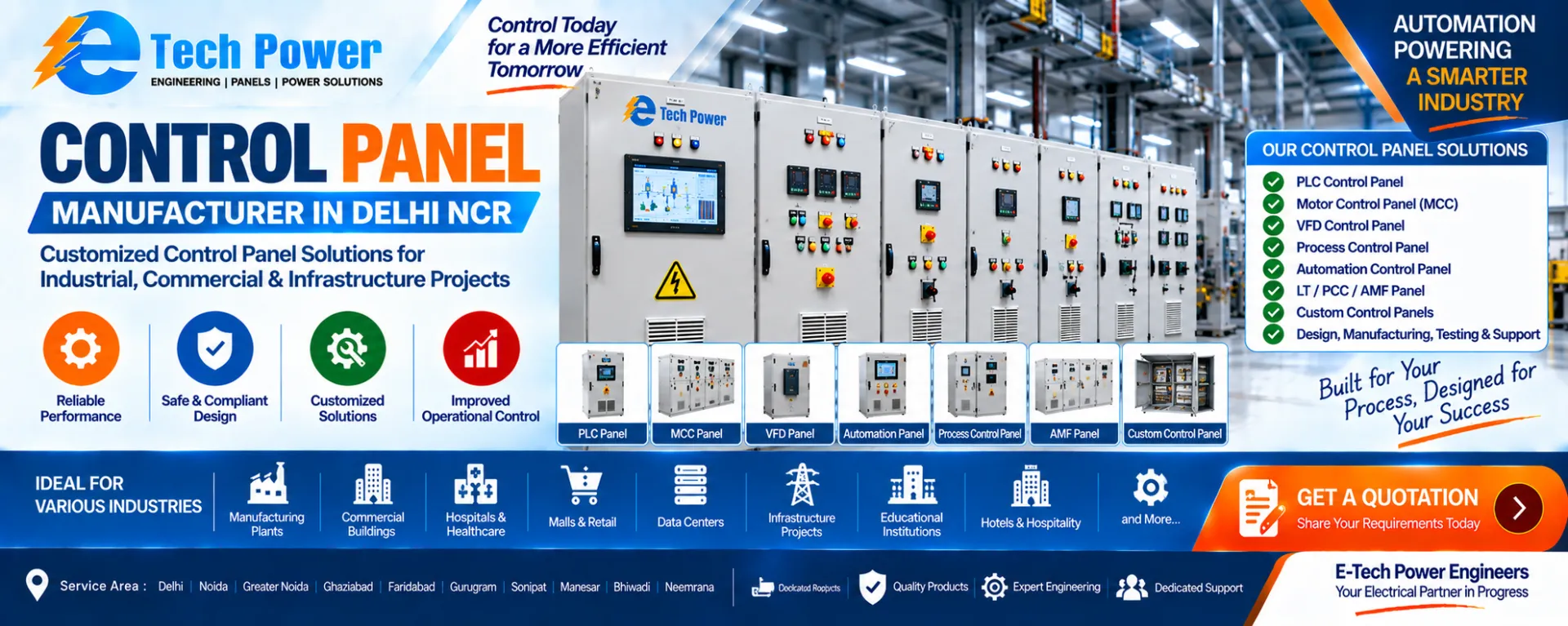
E-Tech Power Engineers is a Control Panel Manufacturer in Delhi NCR, providing customized electrical control panels for industrial automation, motor control, process control, machine control and electrical power management applications.
A control panel combines electrical, electronic and automation components inside an engineered enclosure to control, monitor and protect equipment or industrial processes. Depending on the application, a panel may include PLCs, HMIs, contactors, relays, MCCBs, VFDs, power supplies, meters, communication modules and other control components.
E-Tech Power Engineers is based in Greater Noida and provides customized control panel solutions for industrial, commercial and infrastructure applications across Delhi, Noida, Greater Noida, Ghaziabad, Faridabad and Gurugram.
What Is a Control Panel?
A Control Panel is an electrical enclosure containing components used to control, monitor, automate and protect electrical equipment or industrial processes.
A typical control panel receives input signals, processes them through the selected control system and provides output commands to equipment such as:
- Motors
- Pumps
- Fans
- Compressors
- Conveyors
- Valves
- Production machines
- HVAC equipment
- Process equipment
The control architecture depends on the application and may use relay logic, PLC-based control, VFDs, HMI or a combination of these systems.
How Does a Control Panel Work?
The basic control sequence can be represented as:
Input → Controller → Logic → Output → Equipment → Feedback
For example, sensors or switches provide input signals to a PLC. The PLC processes those signals according to programmed logic and sends output commands to contactors, relays, VFDs, valves or other field devices.
Feedback signals can then be used to monitor equipment status and operating conditions.
Main Functions of Control Panels
A control panel can be designed for:
- Equipment control
- Motor control
- Process automation
- Machine automation
- Start/stop control
- Speed control
- Sequence control
- Interlocking
- Fault indication
- Alarm management
- Electrical protection
- Load management
- Energy monitoring
- HMI-based operation
- PLC-based automation
- Communication with SCADA/BMS
Not every function is required in every panel. The final configuration depends on the application and control philosophy.
Types of Control Panels
Industrial Control Panel
Industrial control panels are designed for controlling machinery, production equipment and industrial processes.
Typical applications include:
- Manufacturing plants
- Production lines
- Packaging systems
- Material handling
- Process industries
- Utility systems
PLC Control Panel
A PLC Control Panel uses a Programmable Logic Controller to execute customized automation and process-control logic.
A PLC panel may include:
- PLC CPU
- Digital I/O
- Analog I/O
- SMPS/DC supply
- Relays
- HMI
- Communication modules
- Terminal blocks
- Protection devices
Motor Control Panel
Motor Control Panels are designed for controlling and protecting electric motors.
They may be used for:
- Pumps
- Compressors
- Fans
- Conveyors
- Blowers
- HVAC systems
- Industrial machinery
Depending on the application, motor control can use DOL, star-delta, soft starter or VFD-based starting.
Automation Control Panel
Automation Control Panels combine control hardware and programmed logic to automate machines or processes.
Possible features include:
- PLC
- HMI
- VFD
- Sensors
- Relays
- Timers
- Communication modules
- Remote I/O
Process Control Panel
Process control panels are used where industrial processes require continuous monitoring and control.
Applications can include:
- Water treatment
- Chemical processing
- Food processing
- Pharmaceutical manufacturing
- Industrial utilities
VFD Control Panel
A VFD Control Panel uses variable frequency drives to control motor speed and acceleration/deceleration.
It can be designed with:
- VFD
- MCCB/MCB
- Contactor where required
- Bypass arrangement
- PLC interface
- HMI
- Protection devices
- Control terminals
Custom Control Panel
Custom panels can be designed according to specific requirements for:
- Panel dimensions
- Control logic
- Component selection
- Number of inputs/outputs
- Motor quantity
- Automation requirements
- Communication
- HMI
- Installation environment
Main Components of a Control Panel
Depending on the application, a control panel may contain:
- PLC
- HMI
- MCCB
- MCB
- Contactors
- Overload relays
- Auxiliary relays
- Timers
- VFDs
- Soft starters
- SMPS
- Control transformers
- Push buttons
- Selector switches
- Indication lamps
- Multifunction meters
- Communication modules
- Terminal blocks
- Surge protection devices
- Safety/control relays
Component selection should be based on the electrical load, control requirements, fault level, environmental conditions and approved project specifications.
PLC and HMI Integration
PLC and HMI integration can provide centralized control and monitoring.
An HMI can display parameters such as:
- Motor status
- Running/stop status
- Fault status
- Alarm status
- Process values
- Set points
- VFD frequency
- Current
- Voltage
- Production/process status
Where required, the PLC can also communicate with SCADA, BMS or other automation systems using the appropriate communication architecture.
Motor Control and Protection
For motor applications, the control panel can incorporate suitable protection against conditions such as:
- Overload
- Short circuit
- Phase failure
- Under/over-voltage
- Motor fault
- Drive fault
The protection arrangement should be coordinated with the motor rating, starting method and upstream/downstream protection.
Control Panel vs MCC Panel vs PLC Panel
| Panel | Primary Purpose |
|---|---|
| Control Panel | General equipment/control functions |
| MCC Panel | Centralized control and protection of multiple motors |
| PLC Panel | Programmable automation and process control |
| VFD Panel | Variable-speed motor control |
| PCC Panel | Main electrical power distribution |
| APFC Panel | Power factor correction |
| AMF Panel | Automatic mains-failure/generator control |
A single project may use several of these panels as part of one integrated electrical and automation system.
Applications of Control Panels
Control panels are used in:
- Manufacturing plants
- Automotive industries
- Pharmaceutical plants
- Food processing
- Chemical industries
- Water treatment plants
- HVAC systems
- Warehouses
- Commercial buildings
- Infrastructure projects
- Material handling systems
- Industrial utilities
The control panel should be designed around the actual equipment and process rather than using a generic configuration.
Control Panel Technical Specifications
| Parameter | Configuration |
|---|---|
| Application | Control / Automation |
| Control System | Relay / PLC / VFD as required |
| HMI | Optional |
| PLC | As per I/O requirement |
| Communication | As required |
| Motor Control | DOL / Star-Delta / Soft Starter / VFD |
| Protection | MCB / MCCB / Overload / Other |
| Metering | As required |
| Enclosure | Customized |
| Installation | Indoor / Outdoor as applicable |
| Cable Entry | Top / Bottom as required |
| Mounting | Floor / Wall mounted as required |
| Cooling | As required by heat-load calculation |
| Customization | Project-specific |
Actual electrical ratings should be finalized from the approved drawings, load schedule and equipment requirements.
Control Panel Manufacturing Process
A typical manufacturing workflow includes:
Requirement Study → Electrical Design → Component Selection → Enclosure Fabrication → Component Mounting → Busbar/Control Wiring → PLC/HMI Programming → Inspection → Testing → Delivery → Installation/Commissioning
For customized projects, the final process follows the approved electrical drawings and project specifications.
Control Panel Testing
Testing should be based on the actual panel design and agreed project requirements.
Possible checks include:
- Visual inspection
- Component verification
- Wiring verification
- Continuity testing
- Insulation resistance testing
- PLC I/O testing
- HMI functionality
- Interlock verification
- Protection/control checks
- Metering verification
- Communication testing
- Functional testing
The existing website specifically mentions functional, wiring, insulation, continuity, protection and load-simulation testing; these should be published only where the particular test is actually performed for the supplied panel.
How to Select a Control Panel
Before ordering a control panel, provide:
- Equipment details
- Motor/load ratings
- Number of motors
- Starting method
- Control philosophy
- PLC requirement
- Number of digital inputs/outputs
- Analog I/O requirements
- HMI requirement
- VFD/soft-starter requirement
- Communication protocol
- Protection requirements
- Panel installation location
- Cable entry requirements
- Electrical SLD and control schematic, if available
For automation projects, an I/O list and control philosophy are especially useful for accurate engineering and quotation.
Control Panel Price in Delhi NCR
Control Panel pricing depends on:
- Panel size
- Number of feeders
- Number of motors
- PLC brand and I/O count
- HMI size
- VFD/soft starter quantity
- Breaker selection
- Control components
- Communication requirements
- Enclosure construction
- Programming requirements
- Installation and commissioning scope
Therefore, a fixed price cannot be accurately determined from the panel name alone.
For an accurate quotation, share your load details, SLD, control schematic, I/O list and automation requirements.
Control Panel Manufacturer in Noida, Greater Noida & Ghaziabad
E-Tech Power Engineers is located at Plot No. 91, Udyog Kendra-II, Ecotech-III, Greater Noida – 201306. The company lists customized control panels, PLC panels, MCC panels, LT panels, PCC panels and other electrical products within its portfolio.
Service areas include:
- Delhi
- Noida
- Greater Noida
- Ghaziabad
- Faridabad
- Gurugram
- Manesar
- Sonipat
- Bhiwadi
- Neemrana
Why Choose E-Tech Power Engineers?
For a control panel project, the important factors are:
- Correct electrical design
- Suitable component selection
- Proper control logic
- Organized wiring
- Protection coordination
- Clear documentation
- Functional testing
- Installation/commissioning support
E-Tech Power Engineers combines control panel manufacturing with electrical engineering and turnkey project capabilities, allowing customized solutions to be developed around the project’s requirements.
Frequently Asked Questions
What is a Control Panel?
A control panel is an electrical enclosure containing components used to control, monitor, protect and automate electrical equipment or industrial processes.
What types of Control Panels does E-Tech Power manufacture?
The company lists industrial control panels, PLC control panels, motor control panels, automation control panels, process control panels and customized control panels.
Can you manufacture PLC-based Control Panels?
Yes. PLC-based control panels can be customized according to the required I/O, process logic, HMI and communication requirements.
Can VFD be integrated into a Control Panel?
Yes. VFDs can be integrated for variable-speed motor control where required.
Can HMI be provided?
Yes. HMI can be incorporated for operator monitoring and control depending on the application.
Can the Control Panel communicate with SCADA?
Yes, where the required PLC, communication modules, protocol and SCADA architecture are included in the project.
What industries use Control Panels?
Control panels are used across manufacturing, pharmaceutical, food processing, chemical, water treatment, HVAC, commercial and infrastructure applications.
What information is required for a quotation?
The most useful information is the SLD, equipment list, motor ratings, control philosophy, I/O list and required automation features.