

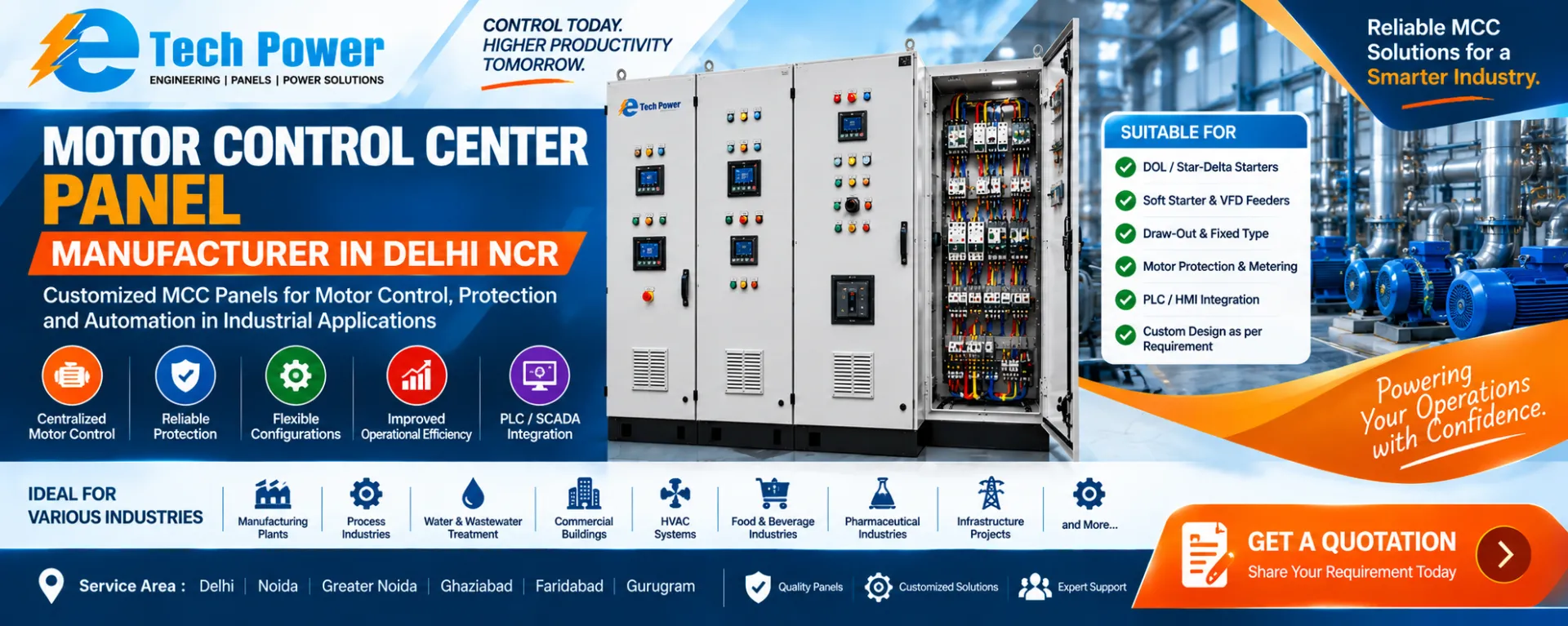
Customized MCC panels for motor control, protection, monitoring and industrial automation
E-Tech Power manufactures Motor Control Center (MCC) Panels for industrial and commercial electrical systems where multiple motors need centralized control, protection and monitoring.
An MCC panel brings multiple motor feeders and associated control equipment together in an organized electrical assembly. Depending on the application, an MCC can be configured with MCCBs, contactors, motor protection devices, overload relays, starters, VFDs, soft starters, meters, PLCs, HMIs and control systems.
MCC panels can be designed as fixed-type, draw-out, VFD-integrated, soft-starter-based or PLC-integrated systems, depending on the motor loads and process requirements.
E-Tech Power serves industrial and commercial requirements across Delhi, Noida, Greater Noida, Ghaziabad, Faridabad and Gurugram.
What Is a Motor Control Center (MCC) Panel?
A Motor Control Center Panel is a centralized electrical assembly used to control and protect multiple electric motors and motor-driven equipment.
Instead of installing individual motor-control equipment at different locations, an MCC brings multiple motor feeders into a common panel structure.
A typical MCC may contain:
- Motor feeders
- MCCBs
- Contactors
- Overload relays
- Motor protection devices
- Starters
- VFDs
- Soft starters
- Control transformers
- Protection relays
- Meters
- PLC and HMI systems
- Busbar systems
- Terminal blocks
The exact configuration depends on the motor rating, starting method, process requirements and control philosophy.
What Does an MCC Panel Do?
The primary functions of an MCC panel include:
Centralized Motor Control
Multiple motors can be controlled from a common electrical panel.
Motor Protection
Individual feeders can be provided with suitable protection against overload, short circuit and other applicable electrical faults.
Power Distribution
The MCC distributes electrical power from the incoming supply to individual motor feeders.
Motor Starting
Different motor-starting methods can be incorporated according to application requirements.
Monitoring
Meters, indication devices and communication systems can be integrated where required.
Automation
MCC panels can interface with PLC, HMI, SCADA or other industrial automation systems when specified.
How Does an MCC Panel Work?
A simplified MCC arrangement is:
Incoming Power
↓
Main Incomer
↓
MCC Busbar
↓
Individual Motor Feeders
↓
Protection + Switching
↓
Motor / Equipment
Each motor feeder is designed according to its individual load.
For example:
MCCB → Contactor → Overload Relay → Motor
or:
MCCB → VFD → Motor
or:
MCCB → Soft Starter → Motor
The appropriate arrangement depends on the motor and process requirements.
Types of Motor Control Center Panels
Fixed-Type MCC Panel
Fixed-type MCC panels use permanently mounted feeder components.
They are commonly considered for conventional industrial motor-control applications where simple maintenance arrangements are acceptable.
Suitable for:
- Manufacturing units
- Pumps
- Fans
- Compressors
- Utility systems
- Small and medium industrial installations
Draw-Out MCC Panel
A draw-out MCC uses withdrawable feeder modules that can be isolated and removed according to the panel design.
This can simplify maintenance and feeder replacement, particularly in larger installations where minimizing maintenance time is important.
Advantages
- Easier feeder maintenance
- Faster replacement
- Better segregation possibilities
- Convenient access
- Reduced maintenance disruption
The actual maintenance benefit depends on the panel design and operating procedure.
VFD Integrated MCC Panel
A VFD-integrated MCC incorporates Variable Frequency Drives for motors that require variable-speed control.
VFDs can be used where the process requires control of motor speed, acceleration, deceleration or process flow.
Typical applications include:
- Pumps
- Fans
- Blowers
- Conveyors
- HVAC systems
- Process machinery
The MCC design should account for VFD heat dissipation, cable arrangement, EMC considerations and harmonic effects where applicable.
Soft Starter MCC Panel
Soft starters can be integrated into MCC feeders where reducing motor starting current and mechanical starting stress is desirable.
Soft starters are commonly considered for applications such as:
- Pumps
- Compressors
- Fans
- Blowers
- Conveyor systems
Selection should be based on motor rating, starting characteristics and duty cycle.
PLC Integrated MCC Panel
An MCC can be integrated with a PLC for automated motor control.
The PLC can receive signals from field instruments and control motor feeders according to the process logic.
A PLC-integrated MCC may support:
- Auto/Manual control
- Interlocking
- Sequence control
- Alarm handling
- Status monitoring
- Process automation
- Communication with HMI/SCADA
The PLC architecture should be selected according to the actual automation requirement.
Main Components of an MCC Panel
A typical MCC may include:
Power Components
- ACB
- MCCB
- MCB
- Busbars
- Isolators
- Fuses where required
Motor Control Components
- Contactors
- Overload relays
- Motor protection circuit breakers
- Star-delta starters
- Soft starters
- VFDs
Control Components
- Control relays
- Timers
- Push buttons
- Selector switches
- Indication lamps
- Control transformers
- Terminal blocks
Automation Components
- PLC
- HMI
- Communication modules
- Remote I/O
- Ethernet/industrial communication equipment
Metering
Depending on the application:
- Voltmeter
- Ammeter
- Multifunction meter
- Energy meter
- Current transformers
Motor Starting Methods in an MCC
Different motors require different starting arrangements.
DOL Starter
Direct-On-Line (DOL) starting is generally used for suitable smaller motors where the starting current and supply-system impact are acceptable.
Star-Delta Starter
Star-delta starting can reduce the starting current compared with DOL starting, subject to suitable motor and load characteristics.
Soft Starter
A soft starter provides controlled starting and stopping and can reduce mechanical stress during starting.
VFD
A VFD provides variable-speed control along with controlled motor starting and stopping.
The starting method should be selected based on:
Motor rating + load characteristics + starting torque + available supply capacity + process requirements.
MCC Panel Protection Features
Protection should be selected according to the motor and electrical system.
Possible protection functions include:
- Short-circuit protection
- Overload protection
- Motor over-temperature protection where applicable
- Phase-loss protection
- Phase-sequence protection where applicable
- Earth-fault protection
- Under-voltage protection
- Over-voltage protection
- Motor-specific electronic protection
Not every MCC requires every protection function. The final protection scheme should be based on the project design.
MCC Panel Applications
MCC panels are suitable for installations where multiple motors and motor-driven systems need centralized electrical control.
Manufacturing Plants
For production machinery, pumps, compressors, conveyors and utility systems.
Water & Wastewater Treatment
For:
- Pumps
- Blowers
- Mixers
- Aeration systems
- Treatment equipment
HVAC Systems
For:
- Chillers
- Pumps
- Cooling towers
- AHUs
- Fans
Food Processing
For processing machines, conveyors, pumps and utility equipment.
Pharmaceutical Plants
For process equipment and facility utilities requiring controlled motor operation.
Chemical Industries
For pumps, agitators, compressors and other motor-driven equipment.
Infrastructure Projects
For suitable motor-control applications in large facilities and infrastructure systems.
MCC Panel vs PCC Panel
| Feature | MCC Panel | PCC Panel |
|---|---|---|
| Primary purpose | Motor control | Power distribution |
| Main loads | Motors | Electrical feeders |
| Contactors | Commonly used | Generally not the primary function |
| Overload protection | Motor-specific | Feeder/system protection |
| VFD integration | Common | Application dependent |
| PLC integration | Common | Application dependent |
| Motor starters | Yes | Normally not the main function |
| Typical application | Motor-driven systems | Main/secondary power distribution |
In many industrial plants, PCC and MCC panels work together rather than replacing each other.
How to Select the Right MCC Panel?
Before designing an MCC, the following information should be evaluated.
1. Motor List
Provide:
- Motor name
- Motor rating
- Voltage
- Full-load current
- Starting method
- Duty
- Quantity
2. Starting Method
Determine whether the motor requires:
DOL / Star-Delta / Soft Starter / VFD
3. Load Profile
Consider whether motors operate:
- Continuously
- Intermittently
- Sequentially
- Simultaneously
4. Control Philosophy
Determine whether the motors will be operated through:
- Local control
- Remote control
- PLC
- HMI
- SCADA
- Automatic sequence
5. Future Expansion
If additional feeders may be required later, adequate space and busbar provisions should be considered during design.
MCC Panel Technical Specifications
Final specifications should be based on the approved project design.
| Parameter | Configuration |
|---|---|
| Panel Type | Fixed / Draw-Out |
| Application | Motor Control |
| System | 3 Phase |
| Voltage | As per project |
| Frequency | As per project |
| Busbar Rating | As required |
| Short-Circuit Rating | As per system study/design |
| Motor Feeders | Customized |
| Starting Method | DOL / Star-Delta / Soft Starter / VFD |
| Protection | MCCB / MPCB / Relays etc. |
| Metering | Optional |
| PLC | Optional |
| HMI | Optional |
| Communication | Optional |
| Enclosure | Indoor / Outdoor as required |
| Form of Separation | As specified |
| Cable Entry | Top / Bottom as required |
Important: Ratings should not be presented as a universal “up to 6300 A / 690 V” promise unless these ratings are actually supported by your tested/approved panel design and components. The current page currently states up to 690 V and 6300 A.
MCC Panel Manufacturing Process
Requirement Analysis
We review the motor schedule, electrical load, starting requirements and control philosophy.
Electrical Design
The MCC single-line diagram, feeder arrangement and control philosophy are developed according to project requirements.
Panel Engineering
Panel dimensions, busbar arrangement, feeder configuration, cable entry and component placement are finalized.
Component Selection
Switchgear, starters, VFDs, protection devices and control components are selected according to the approved design.
Fabrication
The panel enclosure and internal mounting arrangement are fabricated according to the design.
Assembly & Wiring
Power and control components are installed and wired systematically.
Inspection & Testing
Appropriate checks may include:
- Visual inspection
- Wiring verification
- Continuity checks
- Insulation resistance testing
- Functional testing
- Interlock verification
- Control-circuit testing
- Protection/control checks as applicable
Only mention high-voltage testing, load simulation or other specific factory tests if E-Tech Power actually performs and records those tests. The current page claims all three among its testing scope.
MCC Panel Price
The price of an MCC panel depends on its design and component configuration.
Important cost factors include:
- Number of motor feeders
- Motor ratings
- Total busbar rating
- Short-circuit withstand requirement
- Fixed or draw-out construction
- DOL/star-delta starters
- Soft starters
- VFDs
- PLC/HMI
- Metering
- Protection relays
- Enclosure dimensions
- Form of separation
- Copper/aluminium busbars
- Component brands
- Automation requirements
Get an Accurate MCC Panel Quotation
For a project-specific quotation, share:
Motor Schedule + Motor Ratings + Voltage + Starting Method + Quantity + SLD + Control Requirement
An existing panel photograph or electrical drawing can also help our engineering team understand the requirement.
MCC Panel Manufacturer in Delhi NCR
E-Tech Power manufactures customized Motor Control Center Panels for industrial and commercial applications in Delhi NCR.
Service areas include:
Delhi | Noida | Greater Noida | Ghaziabad | Faridabad | Gurugram
Additional locations such as Manesar, Sonipat, Bhiwadi and Neemrana can be included only where service/delivery is actually available. The existing page currently lists these locations.
MCC Panel Manufacturer in Noida
E-Tech Power provides customized MCC solutions for industrial and commercial motor-control applications in Noida.
MCC configurations can be developed according to the required motor feeders, starting method, protection and automation requirements.
MCC Panel Manufacturer in Greater Noida
Located in Ecotech-III, Greater Noida, E-Tech Power serves industrial requirements for customized MCC panels and associated electrical control systems. The company’s listed address is Plot No. 91, Udyog Kendra-II, Ecotech-III, Greater Noida – 201306.
MCC Panel Manufacturer in Ghaziabad
Customized motor-control panels can be designed for suitable industrial applications in Ghaziabad and surrounding industrial areas.
MCC Panel Manufacturer in Faridabad
E-Tech Power can provide MCC solutions for manufacturing and industrial applications in Faridabad according to project requirements.
MCC Panel Manufacturer in Gurugram
Customized MCC panels can be designed for industrial facilities, commercial buildings and utility systems in Gurugram based on the required motor-control architecture.
Why Choose E-Tech Power?
Application-Based Engineering
The MCC should be designed around the actual motor schedule and process requirement rather than using a standard one-size-fits-all configuration.
Customized Feeder Arrangement
Motor feeders can be configured according to the required starting and protection method.
Automation Integration
PLC, HMI and communication functions can be integrated where required.
Maintenance-Oriented Design
Component arrangement, labeling, cable routing and accessibility should be considered during engineering to simplify maintenance.
Technical Support
Installation, commissioning and technical support can be offered according to the agreed project scope.
Frequently Asked Questions
What is an MCC Panel?
An MCC panel is a centralized electrical assembly used to control and protect multiple motors and motor-driven equipment.
What is the difference between MCC and PCC?
An MCC primarily controls motors, while a PCC primarily distributes electrical power to different feeders and loads.
What is a draw-out MCC?
A draw-out MCC uses withdrawable feeder modules, allowing individual units to be isolated and removed according to the panel design.
Can VFDs be installed in an MCC panel?
Yes. VFD feeders can be integrated into an MCC when variable-speed motor control is required.
Can PLC be integrated with an MCC?
Yes. PLC, HMI and communication systems can be integrated for automatic motor sequencing, monitoring and process control.
Which starter is best for a motor?
There is no universal best starter. DOL, star-delta, soft starter and VFD selection depends on motor rating, load characteristics, starting current, torque requirement and process requirements.
What information is required for an MCC quotation?
A motor schedule containing motor rating, voltage, quantity, starting method and control requirement is the most useful starting information. An SLD and load schedule are also helpful.
Do you manufacture customized MCC panels?
Yes, MCC panels can be customized according to motor feeders, protection, starting method, automation, enclosure and project requirements.
Get a Quote for Your MCC Panel
Looking for a Motor Control Center Panel Manufacturer in Delhi NCR?
Share your motor schedule and project requirements with E-Tech Power for a customized MCC panel proposal.
Send or contact us:
- Motor Schedule
- Motor HP/kW
- Voltage
- Quantity
- Starting Method
- SLD
- PLC/Automation Requirement
- Indoor/Outdoor Requirement
- Installation Location