

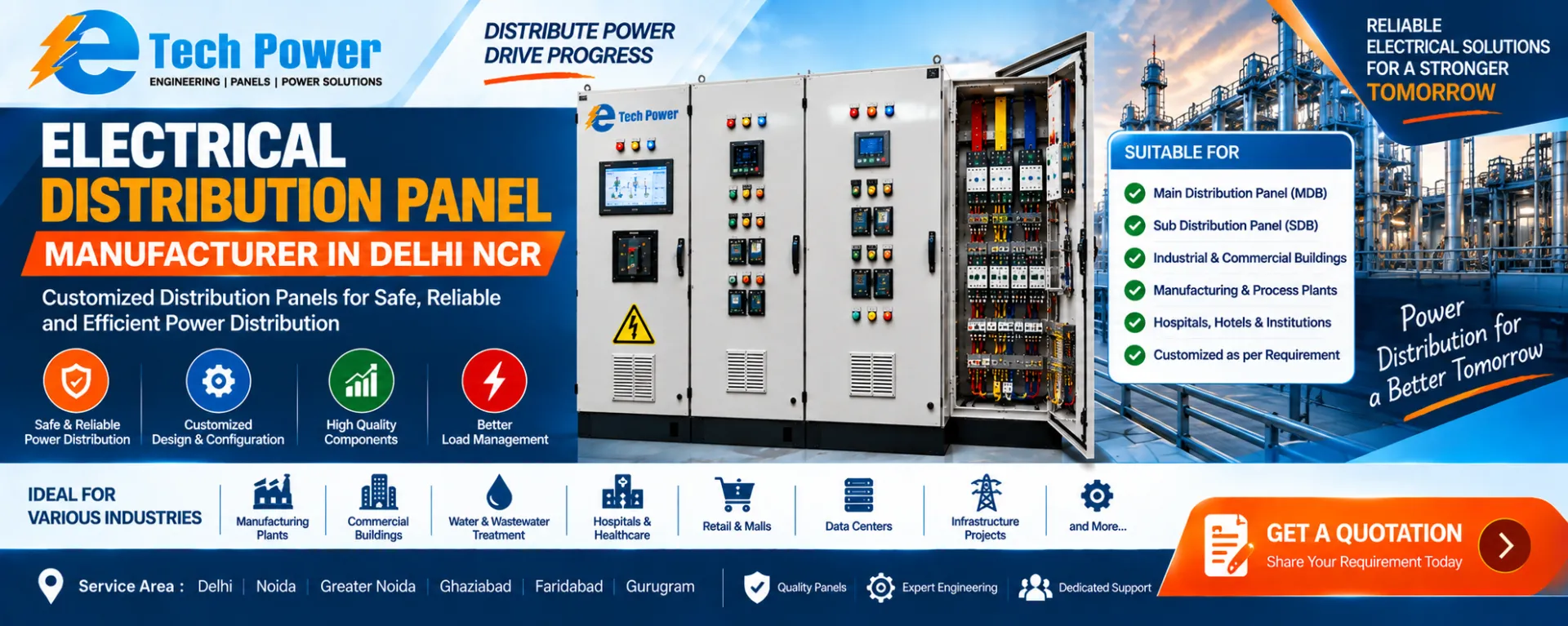
Customized electrical distribution panels for safe, organized and reliable power distribution
E-Tech Power manufactures Electrical Distribution Panels for industrial, commercial and infrastructure electrical systems.
An electrical distribution panel receives electrical power from an incoming source and distributes it to multiple outgoing circuits, feeders and equipment through an organized system of breakers, busbars, isolation devices, metering and protection equipment.
The panel configuration is customized according to the electrical load, incoming supply, number of outgoing feeders, fault level, protection requirements, installation environment and future expansion requirements.
Depending on the project, E-Tech Power can provide Main Distribution Panels, Sub Distribution Panels, Industrial Distribution Panels, Commercial Distribution Panels and customized electrical distribution systems.
E-Tech Power serves customers across Delhi, Noida, Greater Noida, Ghaziabad, Faridabad and Gurugram.
GET A QUOTATION
What Is an Electrical Distribution Panel?
An Electrical Distribution Panel is a centralized electrical assembly used to receive power from an incoming source and distribute it to different electrical circuits or loads.
It provides an organized location for:
- Power distribution
- Circuit protection
- Electrical isolation
- Feeder control
- Metering
- Monitoring
- Fault protection
A simplified arrangement is:
Incoming Supply → Main Protection → Busbar → Outgoing Feeders → Electrical Loads
The exact arrangement depends on the electrical system and project requirements.
How Does an Electrical Distribution Panel Work?
Electrical power enters the panel through the main incoming feeder.
The incoming supply may be connected through an ACB, MCCB, switch-disconnector or another suitable switching/protection device, depending on the system design.
Power is then distributed through the panel’s busbar system to individual outgoing feeders.
Each feeder can have a protective device selected according to the connected load.
For example:
Incoming Supply
↓
Main ACB/MCCB
↓
Main Busbar
↓
Outgoing MCCB/MCB Feeders
↓
Electrical Loads
This arrangement allows different loads or sections of an installation to be supplied and protected through separate feeders.
Main Functions of an Electrical Distribution Panel
A properly engineered distribution panel performs several important functions.
Power Distribution
It distributes incoming electrical power to multiple downstream circuits.
Circuit Protection
Protective devices help protect feeders and connected equipment against applicable electrical faults such as overload and short circuit.
Electrical Isolation
Isolation devices allow circuits or equipment to be disconnected for maintenance or operational requirements.
Metering
Meters can be installed to monitor electrical parameters such as voltage, current, power, energy and power factor.
Feeder Segregation
Separate outgoing feeders allow different sections of an installation to be supplied independently.
System Monitoring
Depending on the selected equipment, electrical parameters and alarms can be monitored locally or integrated into an automation/monitoring system.
Types of Electrical Distribution Panels
Main Electrical Distribution Panel
A Main Distribution Panel is generally installed at the primary distribution point of a facility.
It may receive power from:
- Transformer
- DG set
- Utility supply
- Generator
- UPS system
- Other electrical sources
The main panel can distribute power to multiple downstream panels and major electrical loads.
Sub Distribution Panel
A Sub Distribution Panel receives power from an upstream distribution panel and distributes it to a particular building section, floor, production area or group of loads.
Typical applications include:
- Industrial buildings
- Offices
- Warehouses
- Commercial facilities
- Hotels
- Institutions
Industrial Electrical Distribution Panel
Industrial distribution panels are designed for electrical distribution in manufacturing and process facilities.
Depending on the application, feeders may supply:
- Motors
- Pumps
- Compressors
- HVAC systems
- Production machinery
- Lighting
- Utility equipment
- Process equipment
The panel should be designed according to the actual industrial load and fault conditions.
Commercial Electrical Distribution Panel
Commercial distribution panels are used for electrical distribution in:
- Offices
- Shopping complexes
- Hotels
- Hospitals
- Retail buildings
- Commercial facilities
- Institutional buildings
The number and rating of feeders are selected according to the building’s electrical load schedule.
Customized Electrical Distribution Panel
A customized panel can be engineered according to:
- Incoming supply
- Current rating
- Number of feeders
- Load type
- Short-circuit level
- Protection scheme
- Metering
- Enclosure
- Installation location
- Cable entry
- Future expansion
Main Components of an Electrical Distribution Panel
The components depend on the electrical design and application.
ACB
An Air Circuit Breaker can be used as a main incomer or bus-coupler device in suitable low-voltage distribution systems.
MCCB
Molded Case Circuit Breakers are commonly used for incoming and outgoing feeders where their current and protection characteristics are suitable.
MCB
Miniature Circuit Breakers can be used for smaller outgoing circuits and auxiliary loads where applicable.
Busbar
The busbar system distributes electrical power between the incoming and outgoing circuits.
Busbars may be manufactured using:
- Copper
- Aluminium
The required busbar size should be calculated according to current, temperature rise, short-circuit withstand and installation conditions.
Isolator
An isolator provides a means of electrical isolation where required.
Energy Meter
Meters can monitor electrical parameters such as:
- Voltage
- Current
- Frequency
- Active power
- Reactive power
- Apparent power
- Power factor
- Energy
Current Transformer
CTs may be used for metering and protection applications where required.
Protection Relay
Protection relays can be incorporated where additional electrical protection functions are required.
Surge Protection Device
An SPD can be considered where surge protection is required by the electrical protection design.
Terminal Blocks
Terminal blocks provide organized termination for control and auxiliary wiring.
Electrical Distribution Panel Protection
Protection should be selected according to the electrical system and connected loads.
Depending on the design, the panel may incorporate:
- Short-circuit protection
- Overload protection
- Earth-fault protection
- Over-voltage protection
- Under-voltage protection
- Phase-failure protection
- Surge protection
- Feeder isolation
- Alarm indication
- Electrical metering
Not every project requires every protection function. The final protection arrangement should be determined from the actual electrical design.
Electrical Distribution Panel for Industrial Applications
Industrial facilities often have multiple electrical loads operating at the same time.
A distribution panel can divide the electrical system into dedicated feeders.
For example:
Main Distribution Panel
→ Production Area
→ HVAC
→ Pumps
→ Compressors
→ Lighting
→ Utility Loads
→ Auxiliary Systems
This feeder arrangement can simplify operation, fault isolation and maintenance.
Electrical Distribution Panel for Commercial Buildings
Commercial facilities generally have several categories of electrical loads.
A distribution panel may supply:
- Lighting
- HVAC
- Lifts
- Pumps
- Fire systems
- Office equipment
- Common-area loads
- Utility systems
The final feeder arrangement should be based on the building’s electrical load schedule and distribution architecture.
Electrical Distribution Panel for Manufacturing Plants
Manufacturing plants may require separate feeders for:
- Production machinery
- Motors
- Compressors
- Pumps
- Conveyors
- HVAC
- Lighting
- Utility equipment
The panel can be designed to accommodate different feeder ratings and protection requirements.
Electrical Distribution Panel for Water Treatment Plants
Water and wastewater treatment facilities contain multiple motor-driven and process loads.
Distribution panels may supply:
- Raw water pumps
- Transfer pumps
- Blowers
- Dosing systems
- Mixers
- Filtration equipment
- Control systems
- Auxiliary loads
Where motor automation is required, the distribution panel can be coordinated with MCC and PLC systems.
Electrical Distribution Panel for Hospitals
Hospitals require carefully planned electrical distribution for different categories of loads.
Distribution panels may form part of electrical systems supplying:
- HVAC
- Lighting
- Pumps
- Utility systems
- General building services
Critical and life-safety systems require project-specific redundancy, protection and backup-power architecture.
Electrical Distribution Panel for Warehouses
Warehouse and logistics facilities may require electrical distribution for:
- Lighting
- Conveyors
- Material handling
- Battery charging
- HVAC
- Pumps
- Office areas
- Utility equipment
The feeder arrangement should be developed from the actual load schedule.
Indoor Electrical Distribution Panel
Indoor distribution panels are generally installed in electrical rooms, plant rooms, utility areas or other protected locations.
The enclosure, ventilation, cable entry and component arrangement should be selected according to the installation environment.
Outdoor Electrical Distribution Panel
Outdoor distribution panels require additional consideration because they may be exposed to:
- Rain
- Dust
- Temperature variation
- Sunlight
- Humidity
- Condensation
- Corrosive environments
Depending on the installation, the design may include appropriate:
- Enclosure protection
- IP rating
- Gland arrangements
- Ventilation
- Anti-condensation provisions
- Corrosion protection
The required environmental protection should be determined from the actual site conditions.
Electrical Distribution Panel with Metering
Where electrical monitoring is required, multifunction meters can be integrated into the panel.
Depending on the selected meter, parameters can include:
- Voltage
- Current
- Frequency
- kW
- kVA
- kVAR
- Power factor
- Energy consumption
Communication-enabled meters can also be integrated with monitoring systems where required.
Electrical Distribution Panel with APFC
Where power-factor correction is required, the electrical distribution system can be coordinated with an APFC panel.
The distribution panel handles electrical power distribution, while the APFC system provides reactive-power compensation.
For installations with significant harmonic-producing loads, capacitor and reactor selection should be evaluated carefully.
Internal Link: Power Factor Correction Panel Manufacturer in Delhi NCR
Electrical Distribution Panel vs PDB vs PCC
These terms can sometimes be used interchangeably, but they can represent different levels of electrical distribution depending on the project terminology.
| Panel | Primary Function |
|---|---|
| Electrical Distribution Panel | General electrical power distribution |
| PDB | Power distribution to multiple circuits/feeders |
| MDB | Main-level power distribution |
| SDB | Secondary/local distribution |
| PCC | Central power control/distribution |
| MCC | Motor control and protection |
| APFC | Reactive-power compensation |
| PLC Panel | Automation and process control |
The final panel type should be selected according to the project’s electrical architecture.
How to Select the Right Electrical Distribution Panel?
Incoming Supply
Determine:
- Voltage
- Phase
- Frequency
- Transformer capacity
- DG capacity
- Available fault level
Total Connected Load
Prepare the connected-load and maximum-demand details.
Outgoing Feeders
Identify:
- Number of feeders
- Feeder ratings
- Connected equipment
- Load type
Protection Requirement
Determine the appropriate:
- ACB
- MCCB
- MCB
- Protection relay
- Earth-fault protection
- Surge protection
Short-Circuit Level
The panel and protective devices should be selected according to the available fault level at the installation point.
Installation Environment
Specify whether the panel will be installed:
- Indoors
- Outdoors
- In an electrical room
- In a manufacturing plant
- In a dusty environment
- In a corrosive environment
Future Expansion
If additional feeders are expected in the future, adequate space and provisions can be incorporated during the initial design.
Electrical Distribution Panel Technical Specifications
Final specifications should always be customized according to the approved electrical design.
| Parameter | Configuration |
|---|---|
| Panel Type | Distribution / MDB / SDB / Customized |
| System | Single Phase / Three Phase |
| Voltage | As per project |
| Frequency | As per project |
| Incomer | ACB / MCCB / As specified |
| Outgoing Feeders | Customized |
| Busbar | Copper / Aluminium |
| Current Rating | As required |
| Short-Circuit Rating | As per system design |
| Metering | Optional |
| Protection | As required |
| Installation | Indoor / Outdoor |
| Mounting | Wall / Floor Mounted |
| Cable Entry | Top / Bottom |
| Communication | Optional |
| APFC Integration | Optional |
| Enclosure | As specified |
Electrical Distribution Panel Manufacturing Process
Requirement Analysis
The electrical load schedule, incoming supply, outgoing feeders and installation requirements are reviewed.
Electrical Engineering
The single-line diagram, feeder arrangement, protection scheme and panel configuration are developed.
Component Selection
Breakers, busbars, meters, CTs, protection devices and auxiliary components are selected according to the approved design.
Panel Fabrication
The enclosure is fabricated according to the required dimensions and mounting arrangement.
Busbar Assembly
The busbar system is installed according to the electrical design and required clearances.
Component Assembly
Breakers, meters, terminals, protection devices and auxiliary components are installed.
Wiring
Control and auxiliary wiring is completed according to the approved drawings.
Inspection and Testing
Depending on project requirements, testing may include:
- Visual inspection
- Wiring verification
- Continuity testing
- Insulation resistance testing
- Functional checks
- Metering verification
- Protection/control checks
- Interlock verification where applicable
Specific tests should only be listed if they are actually performed as part of the company’s documented testing process.
Electrical Distribution Panel Price
There is no fixed price for an electrical distribution panel because the cost depends on the electrical and mechanical configuration.
Major cost factors include:
- Current rating
- Number of outgoing feeders
- ACB/MCCB/MCB selection
- Busbar material
- Busbar rating
- Short-circuit rating
- Metering
- CTs
- Protection relays
- Panel dimensions
- Indoor/outdoor construction
- IP requirement
- Cable entry
- Communication
- APFC integration
- Component brands
- Quantity
Get an Accurate Quotation
For an accurate quotation, provide:
Load Schedule + SLD + Incoming Supply + Outgoing Feeder List + Feeder Ratings + Installation Location
You can also send an existing panel photograph or electrical drawing for initial technical discussion.
Electrical Distribution Panel Manufacturer in Delhi NCR
E-Tech Power manufactures customized Electrical Distribution Panels for industrial, commercial and infrastructure applications in Delhi NCR.
Our primary service areas include:
Delhi | Noida | Greater Noida | Ghaziabad | Faridabad | Gurugram
Additional locations can be served according to project requirements and installation scope.
Electrical Distribution Panel Manufacturer in Noida
E-Tech Power provides customized electrical distribution panels for industrial and commercial applications in Noida.
Panels can be configured according to incoming supply, feeder requirements, protection, metering and installation environment.
Electrical Distribution Panel Manufacturer in Greater Noida
E-Tech Power Engineers operates from:
Plot No. 91, Udyog Kendra-II, Ecotech-III, Greater Noida – 201306
The company provides customized electrical panel and power distribution solutions for suitable industrial and commercial applications.
Electrical Distribution Panel Manufacturer in Ghaziabad
Customized electrical distribution panels can be designed for manufacturing units, commercial facilities and utility applications in Ghaziabad and nearby industrial areas.
Electrical Distribution Panel Manufacturer in Faridabad
E-Tech Power can provide customized electrical distribution solutions for suitable industrial and commercial applications in Faridabad.
Electrical Distribution Panel Manufacturer in Gurugram
Customized distribution panels can be developed for industrial facilities, commercial buildings, warehouses and infrastructure projects in Gurugram.
Why Choose E-Tech Power?
Application-Based Design
The panel is designed around the actual electrical load, feeder requirements and installation conditions.
Customized Configuration
The distribution panel can be customized for:
- Incomer arrangement
- Outgoing feeders
- Busbar rating
- Metering
- Protection
- Enclosure
- Cable entry
- Installation environment
Organized Electrical Distribution
Proper feeder segregation and identification can simplify operation and maintenance.
Protection-Oriented Engineering
Protection devices are selected according to the electrical system and connected loads.
Engineering Support
Electrical design, panel assembly, inspection, testing and project support can be provided according to the agreed scope.
Frequently Asked Questions
What is an Electrical Distribution Panel?
An electrical distribution panel is an electrical assembly that receives power from an incoming source and distributes it to multiple outgoing circuits while providing suitable protection and isolation.
What is the difference between a distribution panel and an MDB?
An MDB generally refers to the main distribution board at the primary distribution level, while “distribution panel” is a broader term that can refer to panels used at different levels of an electrical system.
What is the difference between PDB and MCC?
A PDB primarily distributes electrical power, while an MCC is specifically designed for controlling and protecting motors.
Can you manufacture customized electrical distribution panels?
Yes. The panel can be customized according to current rating, number of feeders, protection, metering, enclosure, cable entry and project requirements.
Can an electrical distribution panel be used outdoors?
Yes. Outdoor panels require suitable enclosure and environmental protection based on the actual site conditions.
Can APFC be connected with a distribution panel?
Yes. APFC can be incorporated into or coordinated with the electrical distribution system where power-factor correction is required.
What information is required for quotation?
The most useful information includes:
Load Schedule + SLD + Incoming Supply + Outgoing Feeder Details + Feeder Ratings + Installation Location
How much does an electrical distribution panel cost?
The price depends on current rating, number of feeders, breaker selection, busbar arrangement, metering, protection, enclosure and other project requirements.
Do you provide installation and commissioning?
Installation and commissioning support can be provided according to the agreed project scope.
Get a Quote for an Electrical Distribution Panel
Looking for an Electrical Distribution Panel Manufacturer in Delhi NCR?
Share your electrical requirements with E-Tech Power for a customized panel proposal.