

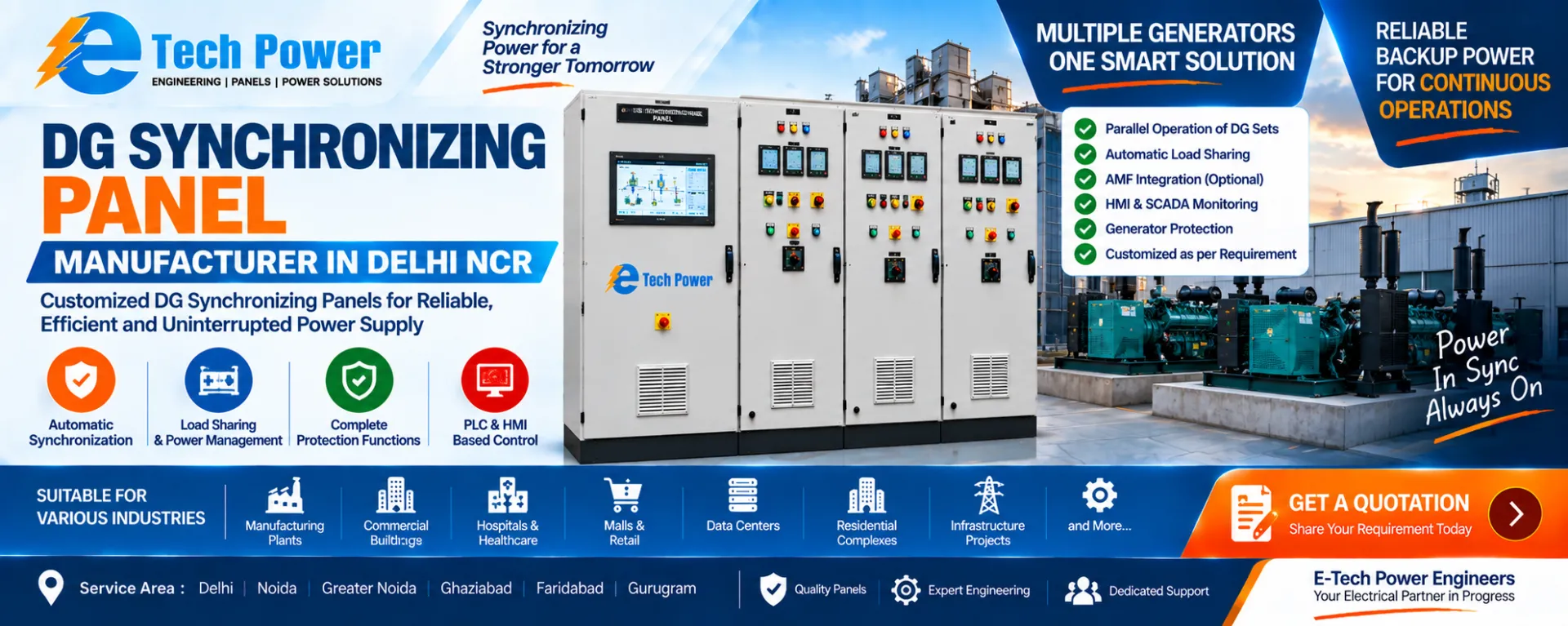
E-Tech Power Engineers is a DG Synchronizing Panel Manufacturer in Delhi NCR, providing customized generator synchronization and load-sharing panels for industrial, commercial, institutional and infrastructure applications.
A DG Synchronizing Panel is designed to safely operate two or more diesel generator sets in parallel by coordinating generator voltage, frequency, phase sequence and phase angle before connecting them to a common busbar. Depending on the project requirement, the system can include automatic synchronization, load sharing, generator protection, AMF integration, HMI monitoring and PLC-based control.
Based in Greater Noida, E-Tech Power Engineers designs and manufactures customized electrical control and power distribution panels for customers across Delhi, Noida, Greater Noida, Ghaziabad, Faridabad and Gurugram.
What Is a DG Synchronizing Panel?
A DG Synchronizing Panel is an electrical control and automation panel used to synchronize multiple diesel generators so that they can operate in parallel on a common electrical bus.
Before a generator breaker is closed, the synchronization system checks important parameters such as:
- Generator voltage
- Frequency
- Phase sequence
- Phase angle
- Generator availability
- Busbar conditions
When the required synchronization conditions are satisfied, the control system permits breaker closing and enables the generators to operate in parallel.
How Does DG Synchronization Work?
A typical automatic DG synchronization system works through the following sequence:
Generator Start → Parameter Monitoring → Synchronization Check → Breaker Closing → Load Sharing → Continuous Monitoring
The synchronization controller continuously receives electrical information from the generators and busbar. It controls the generator or governor/AVR interface, where applicable, to achieve the required synchronization conditions.
After successful synchronization, the load-sharing system distributes the connected load between the running DG sets according to the configured control strategy.
If an abnormal operating condition occurs, the protection system can generate an alarm, initiate a trip or isolate the affected generator depending on the protection scheme.
Main Functions of a DG Synchronizing Panel
A properly engineered synchronization panel can provide:
- Automatic generator synchronization
- Manual synchronization, where required
- Load sharing between DG sets
- Generator breaker control
- Voltage and frequency monitoring
- Phase sequence monitoring
- Reverse power protection
- Overload and short-circuit protection
- Over/under-voltage protection
- Over/under-frequency protection
- Earth-fault protection
- Generator status indication
- Alarm and event monitoring
- Energy and power monitoring
- AMF integration
- HMI-based monitoring
- PLC-based control, where required
- Communication and remote monitoring options
The exact functions depend on generator configuration, controller selection, protection philosophy and project requirements.
Types of DG Synchronizing Panels
Automatic DG Synchronizing Panel
An automatic synchronization panel performs synchronization and generator control with minimum operator intervention.
It is suitable for applications where multiple DG sets need to operate according to changing load requirements.
Manual DG Synchronizing Panel
Manual synchronization systems allow the operator to control generator synchronization using the installed metering, synchronizing and breaker-control arrangement.
These systems can be considered for applications where manual operation is acceptable.
PLC-Based DG Synchronizing Panel
A PLC-based system can be used where customized control logic, HMI operation, alarms, communication and integration with other automation systems are required.
AMF Integrated Synchronizing Panel
An AMF-integrated system combines generator synchronization with Automatic Mains Failure functionality.
Depending on the control philosophy, the system can coordinate utility failure, DG starting, synchronization, breaker operation and load transfer.
Multi-DG Synchronizing Panel
Multi-generator systems can be engineered for two or more DG sets depending on the required generation capacity, control architecture and load-sharing requirements.
Main Components Used in DG Synchronizing Panels
Typical components may include:
- Synchronizing controller
- DG controller
- PLC
- HMI
- ACB/MCCB
- Synchronizing relay
- Protection relays
- Load-sharing controller
- Current transformers
- Voltage sensing circuits
- Multifunction meters
- Power meters
- Auxiliary relays
- Control transformers or SMPS
- DC control supply
- Terminal blocks
- Communication modules
- Busbars
- Control switches and indication lamps
- Emergency stop arrangement
- Panel enclosure
Component selection should be based on DG rating, fault level, generator controller, system voltage, number of DG sets and required protection functions.
DG Load Sharing Panel
When multiple generators operate in parallel, load sharing becomes an important part of the system.
The load-sharing arrangement helps distribute active power between running generators according to the configured control strategy.
For example, if two generators are operating in parallel, the control system can regulate their loading so that one generator does not unnecessarily carry most of the connected load.
The actual load-sharing method depends on the generator controllers, communication architecture and system design.
DG Synchronization vs DG Load Sharing
These two functions are related but not identical.
| Function | Purpose |
|---|---|
| Synchronization | Matches generator electrical parameters before parallel connection |
| Load Sharing | Distributes the electrical load between parallel generators |
| Protection | Detects abnormal conditions and protects equipment |
| AMF | Manages generator operation during utility/mains failure |
| Monitoring | Displays electrical and operational parameters |
This distinction is important when specifying a DG synchronization panel.
Protection Features
Depending on the project design, protection functions may include:
- Overcurrent protection
- Short-circuit protection
- Reverse power protection
- Over-voltage protection
- Under-voltage protection
- Over-frequency protection
- Under-frequency protection
- Earth-fault protection
- Synchronization failure protection
- Breaker failure indication/protection
- Generator trip indication
- Emergency shutdown interface
- Communication failure alarm
The final protection scheme should be selected according to the generator manufacturer’s recommendations and the project’s electrical protection philosophy.
DG Synchronizing Panel with HMI
An HMI can provide an operator interface for viewing:
- DG status
- Voltage
- Current
- Frequency
- kW
- kVA
- Power factor
- Generator running status
- Breaker status
- Load percentage
- Alarms
- Trip indications
- Synchronization status
HMI functionality can be customized according to the project’s monitoring and operating requirements.
PLC-Based DG Synchronization
For larger or more integrated power systems, a PLC-based architecture can provide customized control logic and communication with other electrical or automation systems.
Possible integration options include:
DG Controller → PLC → HMI → Communication Network → SCADA/BMS, where required.
SCADA or remote monitoring should be specified only where the required communication hardware, software and network infrastructure are included in the project.
Applications of DG Synchronizing Panels
DG synchronization systems are commonly considered for facilities such as:
- Manufacturing plants
- Industrial units
- Commercial buildings
- Hospitals
- Hotels
- Warehouses
- Data centres
- Infrastructure projects
- Large residential/commercial complexes
- Process industries
- Critical-load facilities
The suitability of the synchronization arrangement depends on the generator configuration, connected load and required operating philosophy.
DG Synchronizing Panel vs AMF Panel
| DG Synchronizing Panel | AMF Panel |
|---|---|
| Primarily designed for parallel operation of multiple DGs | Primarily manages mains failure and DG starting/changeover |
| Supports generator synchronization | Starts DG during mains failure |
| Supports load sharing | Typically transfers load between mains and DG |
| Suitable for multiple parallel DG sets | Suitable for automatic backup generation |
| More complex control architecture | Comparatively simpler for single-DG applications |
An AMF function can also be integrated into a DG synchronization system when required.
How to Select a DG Synchronizing Panel
Before ordering a synchronization panel, provide the following information:
- Number of DG sets
- DG rating in kVA
- Generator voltage
- Frequency
- Generator controller details
- Number of generators required to run in parallel
- Maximum connected load
- Essential and non-essential loads
- Load-sharing requirement
- AMF requirement
- HMI requirement
- SCADA/BMS integration requirement
- Communication protocol
- Installation location
- Required protection functions
- Existing PCC/MDB/busbar arrangement
This information helps the panel manufacturer develop the appropriate synchronization and control architecture.
Technical Specifications
DG synchronization panels can be customized according to project requirements.
Typical configuration parameters include:
| Parameter | Configuration |
|---|---|
| System | DG Parallel Synchronization |
| Number of DGs | 2 / 3 / Multiple |
| Control | Automatic / Manual / PLC-based |
| Monitoring | Meter / HMI |
| Load Sharing | As per system design |
| AMF | Optional |
| SCADA | Optional |
| Communication | As required |
| Protection | As per approved scheme |
| Enclosure | Indoor / Outdoor as required |
| Busbar | As per system rating |
| Breaker | ACB/MCCB as required |
Actual ratings should be finalized from the project’s DG capacity, fault level, load requirements and applicable electrical design standards.
Manufacturing and Testing
E-Tech Power Engineers can manufacture customized DG synchronization panels according to the approved electrical design and project requirements.
The manufacturing workflow may include:
Requirement Study → Electrical Design → Component Selection → Enclosure Fabrication → Busbar Work → Wiring → Controller Integration → Inspection → Functional Testing → Delivery/Commissioning
Testing and inspection should be performed according to the agreed project specifications and the actual testing facilities available for the supplied panel.
DG Synchronizing Panel Price in Delhi NCR
The price of a DG Synchronizing Panel depends on several factors, including:
- Number of DG sets
- DG capacity
- Breaker rating
- Synchronizing controller
- PLC requirement
- HMI requirement
- Load-sharing arrangement
- AMF integration
- Communication requirements
- Panel dimensions
- Busbar rating
- Protection requirements
- Installation and commissioning scope
Therefore, a fixed price should not be assumed without reviewing the generator and load details.
For an accurate quotation, share your DG rating, number of DG sets and required synchronization configuration with E-Tech Power Engineers.
DG Synchronizing Panel Manufacturer in Noida, Greater Noida & Ghaziabad
E-Tech Power Engineers is based at Plot No. 91, Udyog Kendra-II, Ecotech-III, Greater Noida – 201306 and serves industrial and commercial customers across Delhi NCR.
Service areas include:
- Delhi
- Noida
- Greater Noida
- Ghaziabad
- Faridabad
- Gurugram
- Manesar
- Sonipat
- Bhiwadi
- Neemrana
Actual installation/service availability should be confirmed according to the project location and scope.
Why Choose E-Tech Power Engineers?
When selecting a DG synchronizing panel manufacturer, focus on engineering compatibility rather than only panel price.
E-Tech Power Engineers can provide customized panel solutions based on:
- Number and rating of DG sets
- Required synchronization philosophy
- Generator controller compatibility
- Load-sharing requirements
- Protection requirements
- HMI/PLC requirements
- Communication requirements
- Site-specific electrical configuration
This approach helps ensure that the synchronization panel is designed around the actual generator and load system.
Frequently Asked Questions
What is a DG Synchronizing Panel?
A DG Synchronizing Panel is used to safely synchronize two or more diesel generators so they can operate in parallel on a common busbar.
Why is synchronization required between DG sets?
Synchronization is required to ensure that generator voltage, frequency, phase sequence and phase angle are within the required conditions before parallel connection.
Can two DG sets run in parallel?
Yes, provided the generators, controllers, switchgear and synchronization system are properly designed for parallel operation.
Can more than two DGs be synchronized?
Yes. Multi-DG synchronization systems can be designed for multiple generators according to the required generation capacity and control architecture.
What is the difference between synchronization and load sharing?
Synchronization allows a generator to connect safely to a common bus. Load sharing controls how the connected electrical load is distributed between parallel generators.
Can AMF be integrated with a DG synchronization panel?
Yes. AMF functionality can be integrated where the project requires automatic mains-failure and generator-management functions.
Can PLC and HMI be used?
Yes. PLC and HMI can be incorporated where customized automation, monitoring, alarms, communication or integration requirements exist.
What information is required for quotation?
Normally, the manufacturer needs DG quantity, DG kVA rating, voltage, generator controller details, load details, breaker requirements and required automation/protection functions.
Get a DG Synchronizing Panel Quotation
Looking for a DG Synchronizing Panel Manufacturer in Delhi NCR?
Share your DG capacity, number of generators, load details and required automation features with E-Tech Power Engineers.