

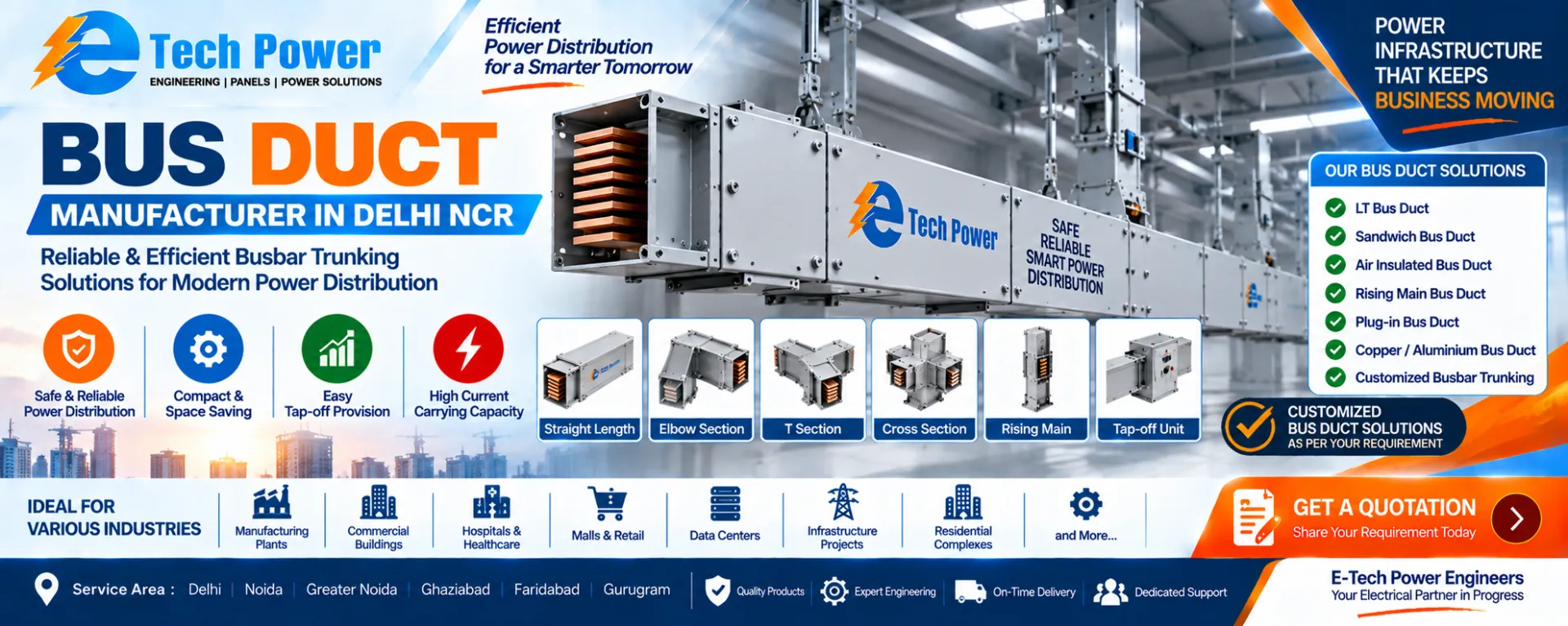
E-Tech Power Engineers is a Bus Duct Manufacturer in Delhi NCR, providing customized busbar trunking and busway solutions for industrial, commercial and infrastructure power distribution applications.
A Bus Duct, also known as a Busbar Trunking System (BTS) or busway, uses enclosed conductors to transmit and distribute electrical power through a compact, modular system. Compared with conventional cable-based distribution, busbar trunking can offer a more organized installation, efficient space utilization and convenient provision for tap-off connections where the system is properly designed.
E-Tech Power Engineers is based in Greater Noida and serves electrical power distribution projects across Delhi, Noida, Greater Noida, Ghaziabad, Faridabad and Gurugram.
What Is a Bus Duct?
A Bus Duct is an enclosed electrical power distribution system in which busbars are housed inside a protective enclosure.
Depending on the design, the conductors may be made from copper or aluminium and may use air insulation or a compact/sandwich construction.
Busbar trunking systems are commonly used for:
- High-current power distribution
- Transformer-to-PCC connections
- PCC-to-MCC power distribution
- Vertical rising-main distribution
- Industrial production areas
- Commercial buildings
- Data centres
- Large infrastructure facilities
For low-voltage busbar trunking, IEC 61439-6 specifies requirements, technical characteristics and verification requirements for busbar trunking systems.
How Does a Busbar Trunking System Work?
The basic power flow is:
Transformer / DG / Power Source → Incomer → Busbar Trunking → Tap-Off Unit → Downstream Load
The enclosed busbars carry electrical current along the designated route.
Where the design permits, tap-off units can be installed at selected points to supply downstream equipment or distribution panels.
This modular approach can be particularly useful where multiple loads are distributed along a defined route.
Bus Duct vs Conventional Cable
Both systems can be used for electrical power distribution, but their physical construction and installation approach are different.
| Bus Duct | Conventional Cable |
|---|---|
| Enclosed busbar conductors | Individual cables |
| Compact route possible | Can require larger cable trays/space |
| Modular tap-off options | Individual cable termination |
| Suitable for high-current distribution | Flexible for many applications |
| Standardized sections and joints | Cable lengths and routing vary |
| Easy expansion in suitable systems | Expansion may require additional cables |
| Organized power distribution | More individual cable management |
The correct choice depends on current rating, route length, fault level, installation environment, accessibility, expansion requirements and overall project economics.
Modern busbar trunking systems are promoted as flexible and space-efficient alternatives to conventional cabling in many industrial and commercial applications.
Types of Bus Duct Systems
LT Bus Duct
LT Bus Ducts are designed for low-voltage power distribution applications.
Typical applications include:
- Transformer connections
- PCC/MCC connections
- Industrial power distribution
- Commercial buildings
- Data centres
- Large electrical installations
For LV busbar trunking, the applicable design and verification requirements should be established according to the selected system and applicable standards.
Sandwich Bus Duct
A sandwich busbar trunking system uses closely arranged insulated conductors within a compact enclosure.
Its compact construction can be useful where:
- Installation space is limited
- High current distribution is required
- Multiple tap-off points are needed
- A structured power distribution route is preferred
Air-Insulated Bus Duct
Air-insulated busbar systems maintain greater separation between conductors and use air as the primary insulation medium.
They may be considered for suitable industrial and power distribution applications depending on the required electrical and environmental conditions.
Rising Main Bus Duct
A rising-main busbar trunking system is used for vertical power distribution in multi-storey buildings.
Typical applications include:
- Commercial towers
- Residential buildings
- Hotels
- Hospitals
- Institutional buildings
Rising-main systems can provide a structured method of distributing power from floor to floor.
Feeder Bus Duct
A feeder busway is primarily used to carry power between major electrical distribution points, such as a transformer and main distribution/switchboard.
Plug-In Bus Duct
Plug-in busway systems provide designated tap-off locations for connecting downstream loads or distribution equipment.
The available tap-off arrangement depends on the selected busway design.
Copper Bus Duct vs Aluminium Bus Duct
Copper Bus Duct
Copper offers high electrical conductivity and is commonly considered where conductor size, electrical performance and installation requirements justify its use.
Potential advantages include:
- High conductivity
- Good electrical performance
- Compact conductor dimensions for a given current
- Suitable for demanding applications
Aluminium Bus Duct
Aluminium can provide a lower-weight conductor solution and may be selected where weight, material cost and system design are important considerations.
Potential advantages include:
- Lower conductor weight
- Good conductivity
- Cost considerations
- Easier handling in suitable applications
The selection should be based on current rating, temperature rise, voltage drop, short-circuit withstand, installation conditions and project economics, rather than material name alone.
Main Components of a Bus Duct System
A complete busbar trunking installation may include:
- Busbar trunking sections
- Copper/aluminium conductors
- Insulation system
- Housing/enclosure
- Joint packs
- Joint covers
- Tap-off units
- End feed units
- End covers
- Flanges
- Flexible connections
- Hangers/supports
- Expansion arrangements where required
- Earthing/PE arrangement
The actual components depend on the selected system and installation design.
Bus Duct Tap-Off Units
Tap-off units are an important advantage of suitable plug-in busbar trunking systems.
They allow electrical power to be taken from the busway at designated locations and supplied to downstream:
- MCCs
- DBs
- Distribution panels
- Machinery
- Production equipment
- Other electrical loads
Tap-off units must be compatible with the busway system and selected according to their electrical rating and protection requirements.
Bus Duct Protection
A properly engineered busbar trunking system should address both electrical and environmental requirements.
Important design considerations include:
- Short-circuit withstand capability
- Insulation system
- Temperature rise
- Joint integrity
- Earthing continuity
- Enclosure protection
- Mechanical strength
- Voltage drop
- Installation environment
IP protection should be specified according to the actual system design and tested/verified configuration rather than publishing a generic list of IP54/IP55/IP65/IP66 for every product.
Where Are Bus Duct Systems Used?
Busbar trunking systems can be used in:
Manufacturing Plants
For distributing power to production machinery, MCCs and other industrial loads.
Commercial Buildings
For structured power distribution in large commercial facilities.
Data Centres
For high-density electrical distribution where modularity and organized routing are important.
Hospitals
For suitable power distribution sections within healthcare facilities.
Warehouses
For distributing power to equipment, utilities and building services.
Hotels and High-Rise Buildings
Rising-main busbar systems can be used for vertical distribution between floors.
Infrastructure Projects
Suitable busway systems can be considered for large infrastructure electrical networks.
Industrial Utility Areas
Bus ducts can be used for distribution between transformers, switchboards and major loads.
Advantages of Bus Duct Systems
Depending on the system design, busbar trunking can provide:
- Compact power distribution
- Organized installation
- Modular construction
- Convenient tap-off connections
- Efficient use of installation space
- Easier expansion in suitable applications
- Reduced cable congestion
- Simplified route planning
- Suitable high-current distribution
However, actual performance and installation benefits depend on the busway design, installation quality, electrical loading and environmental conditions.
Bus Duct Selection Guide
Before selecting a Bus Duct, consider:
- Rated current
- System voltage
- Frequency
- Number of phases
- Neutral requirement
- PE/earth arrangement
- Short-circuit withstand requirement
- Ambient temperature
- Installation environment
- Indoor/outdoor installation
- IP requirement
- Route length
- Number and location of tap-offs
- Copper or aluminium conductor
- Voltage-drop requirement
- Transformer/DG rating
- Connection to PCC/MCC/LT Panel
- Future expansion requirements
A proper Single Line Diagram, load schedule and busway route drawing can significantly improve the accuracy of the design and quotation.
Bus Duct Technical Specifications
The final specifications should be project-specific.
| Parameter | Configuration |
|---|---|
| System | Busbar Trunking / Busway |
| Application | Power Distribution |
| Conductor | Copper / Aluminium |
| Voltage | As per project |
| Current Rating | As per calculated load |
| Frequency | As required |
| Phase | 3 Phase / 4 Wire / 5 Wire as required |
| Neutral | As required |
| PE/Earth | As per system design |
| Insulation | As per selected busway design |
| Enclosure | Metal enclosed |
| IP Rating | As required and verified |
| Tap-Off | Optional / As required |
| Installation | Indoor / Outdoor as applicable |
| Mounting | Horizontal / Vertical as required |
| Joint System | As per manufacturer design |
| Short-Circuit Rating | As per project fault level |
Do not publish “6300A and above” or “33kV and above” as a blanket E-Tech Power specification unless the company can substantiate those exact product configurations. The existing page currently states these ratings.
Bus Duct Manufacturing Process
A typical project workflow can include:
Requirement Study → Load Calculation → Route Study → Electrical Design → Busbar Selection → Enclosure Design → Fabrication → Insulation/Assembly → Joint & Tap-Off Arrangement → Inspection → Testing → Delivery → Installation/Commissioning
For a large project, the busway route and connection points should be coordinated with transformer, PCC, MCC and downstream equipment layouts.
Bus Duct Testing and Verification
Testing should be based on the applicable standard, approved design and actual testing capability.
For low-voltage busbar trunking, IEC 61439-6 defines verification requirements for the applicable busbar trunking system.
Depending on the system and project scope, checks may include:
- Visual inspection
- Dimensional inspection
- Continuity verification
- Insulation resistance
- Dielectric/withstand verification where applicable
- Joint inspection
- Protective-circuit continuity
- Functional checks of tap-off units
- Verification against approved drawings
Temperature-rise and other design verifications should only be claimed where the particular system/configuration has actually been verified.
Bus Duct Price in Delhi NCR
Bus Duct pricing depends on:
- Current rating
- Conductor material
- Busway type
- Voltage
- Route length
- Number of joints
- Number of tap-off units
- IP requirement
- Short-circuit rating
- Installation height
- Indoor/outdoor environment
- Accessories
- Installation and commissioning
Therefore, a reliable quotation requires the SLD, load details and bus duct route/length.
Bus Duct Manufacturer in Noida, Greater Noida & Ghaziabad
E-Tech Power Engineers is located at:
Plot No. 91, Udyog Kendra-II, Ecotech-III, Greater Noida – 201306
The company serves electrical power distribution requirements across Delhi NCR, including:
- Delhi
- Noida
- Greater Noida
- Ghaziabad
- Faridabad
- Gurugram
- Manesar
- Sonipat
- Bhiwadi
- Neemrana
Project-specific installation and commissioning availability should be confirmed according to the scope.
Why Choose E-Tech Power Engineers?
For a Bus Duct project, the important considerations are:
- Correct current rating
- Proper route design
- Suitable conductor material
- Short-circuit withstand
- Joint design
- Tap-off arrangement
- Environmental protection
- Transformer/PCC/MCC compatibility
- Installation support
E-Tech Power Engineers can develop the solution around the project’s electrical distribution requirements rather than treating every busway installation as a standard product.
Frequently Asked Questions
What is a Bus Duct?
A Bus Duct, or busbar trunking system, is an enclosed electrical distribution system using busbars to transmit and distribute power.
What is the difference between Bus Duct and Busbar Trunking?
In many electrical applications, Bus Duct, Busway and Busbar Trunking System are used to describe similar enclosed busbar distribution systems.
Is Bus Duct better than cables?
Not universally. Busway can be advantageous for high-current, structured and modular distribution, while cables may be preferable for other layouts and applications.
Can Bus Duct be used between a transformer and PCC?
Yes, suitably rated busbar trunking can be used for transformer-to-switchboard connections when the electrical and mechanical requirements are correctly designed.
Can Bus Duct be used for vertical distribution?
Yes. Rising-main busbar trunking systems are specifically used for vertical distribution in multi-storey buildings.
Can Bus Duct have tap-off points?
Yes. Plug-in busway systems can provide tap-off units at designated locations according to the system design.
Which is better: copper or aluminium Bus Duct?
The choice depends on current rating, voltage drop, temperature rise, weight, installation requirements and project economics.
What information is required for Bus Duct quotation?
Provide the SLD, transformer/DG rating, required current, voltage, route length, number of tap-offs and installation details.